Could Our Entire Universe Exist Inside Something Else? A Bold New Theory Is Challenging Everything We Know
What if the universe we call home is not the ultimate reality—but instead exists inside something even greater? A provocative new theoretical proposal suggests our universe could be contained within an enormous black hole or a higher-dimensional cosmic structure.
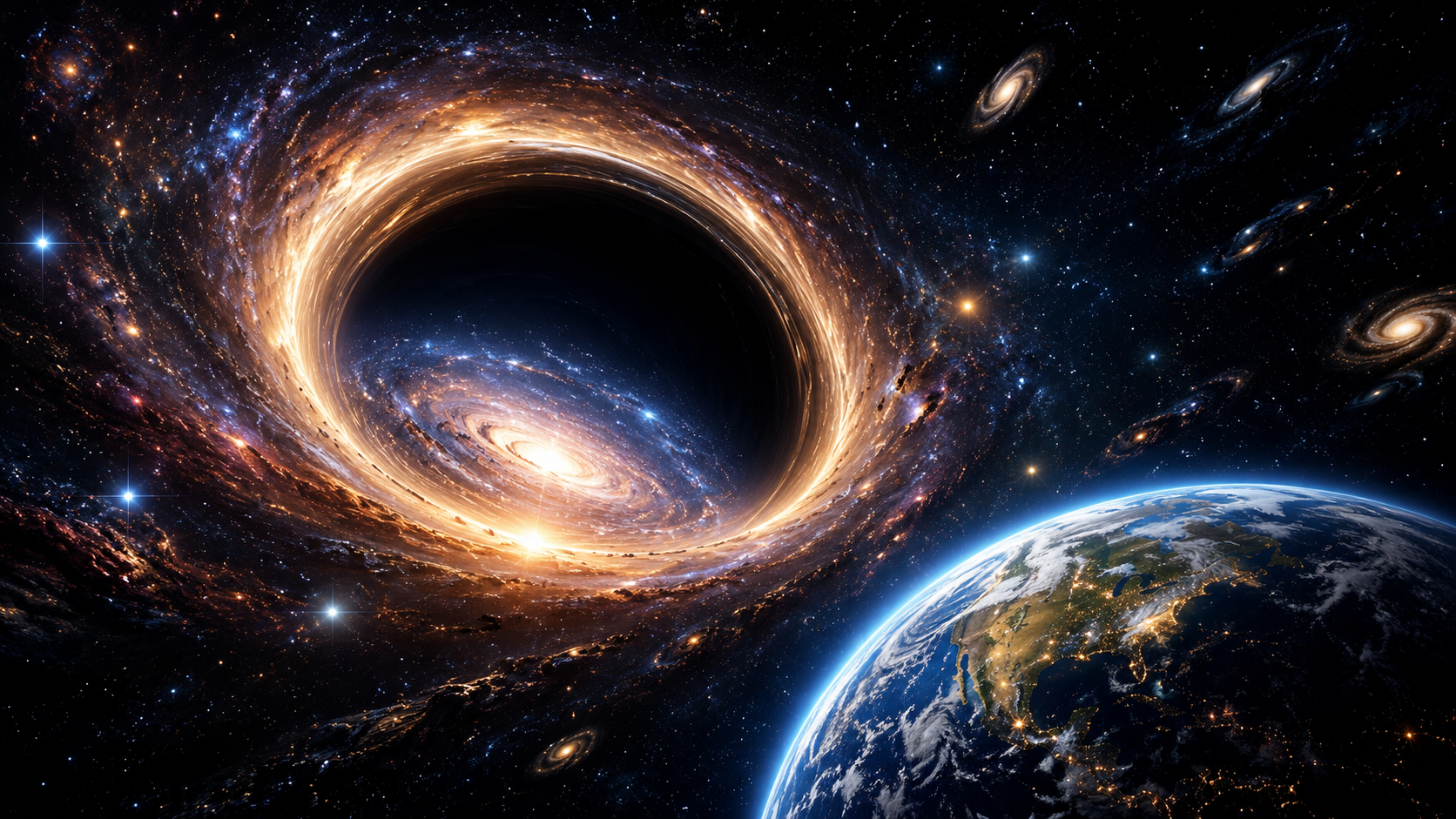
What if the universe we call home is not the ultimate reality—but instead exists inside something even greater?
For centuries, humanity has looked to the stars and asked the same profound questions: Where did the universe come from? Is space truly infinite? What existed before the Big Bang?
Now, a provocative new theoretical proposal is adding another possibility to the list. It suggests that our universe may not be the whole story. Instead, it could be part of a much larger cosmic structure beyond anything we have ever observed.
The idea sounds like science fiction, yet it emerges from serious attempts by physicists to solve some of the biggest mysteries in modern science.
Although there is no direct evidence proving this hypothesis, it is attracting attention because it offers fresh ways to think about gravity, space-time, and the origin of the cosmos.
Beyond the Universe We Can See
Everything we know—from Earth and the Solar System to the billions of galaxies observed by powerful telescopes—belongs to what scientists call the observable universe. This region stretches roughly 46 billion light-years in every direction, limited by the age of the universe and the speed of light.
But many physicists believe the observable universe is only a tiny fraction of the entire cosmos. The universe itself may extend far beyond what we can ever detect.
Some theories go even further, proposing that our universe is just one "bubble" among countless others, each with its own physical laws.
The latest proposal pushes this concept another step forward. Instead of existing independently, our universe might itself be contained within a larger physical system—perhaps the interior of an enormous black hole or a higher-dimensional cosmic structure.
Why Scientists Are Considering Such Radical Ideas
Modern physics faces several puzzles that remain unsolved.
Gravity behaves differently from the other fundamental forces. Dark matter and dark energy appear to dominate the universe, yet nobody knows their true nature.
The Big Bang explains how the universe expanded, but not what caused it or what, if anything, came before.
Because existing theories cannot answer these questions completely, researchers continue exploring new mathematical models. Some of these models naturally lead to the possibility that universes can exist inside larger structures.
One intriguing hypothesis suggests that every black hole might create a new region of space-time. From the outside, it appears as a black hole.
But inside, the collapsing matter could give rise to an entirely new expanding universe. If that is possible, our own universe might have originated inside a black hole existing within another universe.
The Black Hole Universe Hypothesis
Black holes are among the most mysterious objects in existence. They contain so much mass packed into such a tiny region that their gravity prevents even light from escaping.
Traditional physics predicts that matter falling into a black hole is crushed into an infinitely dense singularity. However, many researchers believe that singularities signal the breakdown of our current theories rather than physical reality.
Some newer models replace the singularity with an extreme but finite state where quantum effects become important. Instead of ending space and time, these effects could trigger the birth of a new expanding universe.
From the perspective of observers inside that new universe, it would appear to begin with something remarkably similar to the Big Bang.
In this picture, black holes become cosmic birthplaces rather than dead ends.
A Universe Inside a Larger Reality
If this hypothesis is correct, our universe would not be unique.
It could simply be one branch of an enormous cosmic family tree, where every universe produces new universes through black holes. Each new universe could inherit slightly different physical properties from its parent.
Some scientists have compared this process to biological evolution. Universes that naturally produce many black holes would create more offspring universes, making certain physical laws more common over cosmic time.
Although highly speculative, this idea provides an elegant way to explain why our universe appears finely tuned for long-lived stars, galaxies, and complex structures.
Could We Ever Prove It?
This is the biggest challenge.
By definition, anything beyond our universe is extraordinarily difficult—perhaps impossible—to observe directly. Scientists therefore search for indirect evidence.
Researchers examine the cosmic microwave background, the faint afterglow left from the early universe, looking for unusual patterns that existing theories cannot explain.
Others investigate gravitational waves, black hole behavior, and the mathematics of quantum gravity. If future observations match predictions made by these new models while conflicting with standard cosmology, confidence in these ideas could grow.
At present, however, no experiment has confirmed that our universe exists inside another structure.
What About Other Dimensions?
The proposal also connects with ideas from string theory and higher-dimensional physics.
Some versions of string theory suggest that our familiar three-dimensional universe exists on a higher-dimensional object called a "brane." Other dimensions may surround us while remaining invisible because particles of ordinary matter cannot move through them.
If higher dimensions exist, they could provide entirely new ways to understand gravity, black holes, and even the birth of universes.
Although experimental confirmation remains elusive, these concepts continue to inspire active theoretical research.
The Importance of Mathematical Models
Modern physics often advances through mathematics long before direct observations become possible.
Albert Einstein predicted gravitational waves nearly a century before detectors observed them. Black holes were also once considered mathematical curiosities before astronomical evidence confirmed their existence.
For that reason, physicists continue developing bold theoretical models. Most will eventually prove incorrect, but some may reveal entirely new aspects of reality.
The possibility that our universe exists inside a larger cosmic structure belongs to this tradition of exploring ideas that stretch the limits of human imagination while remaining grounded in mathematics.
A Humbling Perspective
Whether or not this hypothesis turns out to be correct, it reminds us how little we truly know about the cosmos.
Only about five percent of the universe consists of ordinary matter. The remaining ninety-five percent is thought to be dark matter and dark energy, whose true nature remains unknown.
Every major advance in astronomy has revealed that reality is larger and stranger than previously believed. Earth was not the center of the Solar System.
The Solar System was not the center of the galaxy. Our galaxy is only one among hundreds of billions.
It would not be unprecedented if the universe itself turned out to be just one layer of an even greater cosmic reality.
Looking Ahead
Future observatories, more sensitive gravitational-wave detectors, improved black hole observations, and advances in quantum gravity may provide clues that help scientists evaluate these extraordinary ideas.
For now, the notion that our universe exists inside something larger remains an intriguing scientific hypothesis rather than an established fact. Yet history has shown that today's bold speculation can become tomorrow's accepted science.
As researchers continue exploring the deepest mysteries of existence, one question remains impossible to ignore:
What if the universe is not the final destination, but only the beginning of an even greater reality?