Tiny Icy Object Beyond Pluto May Have an Atmosphere, Surprising Scientists
Researchers have found evidence that a small icy object at the edge of the Solar System may possess an atmosphere—an unexpected discovery that could change what scientists know about distant frozen worlds.
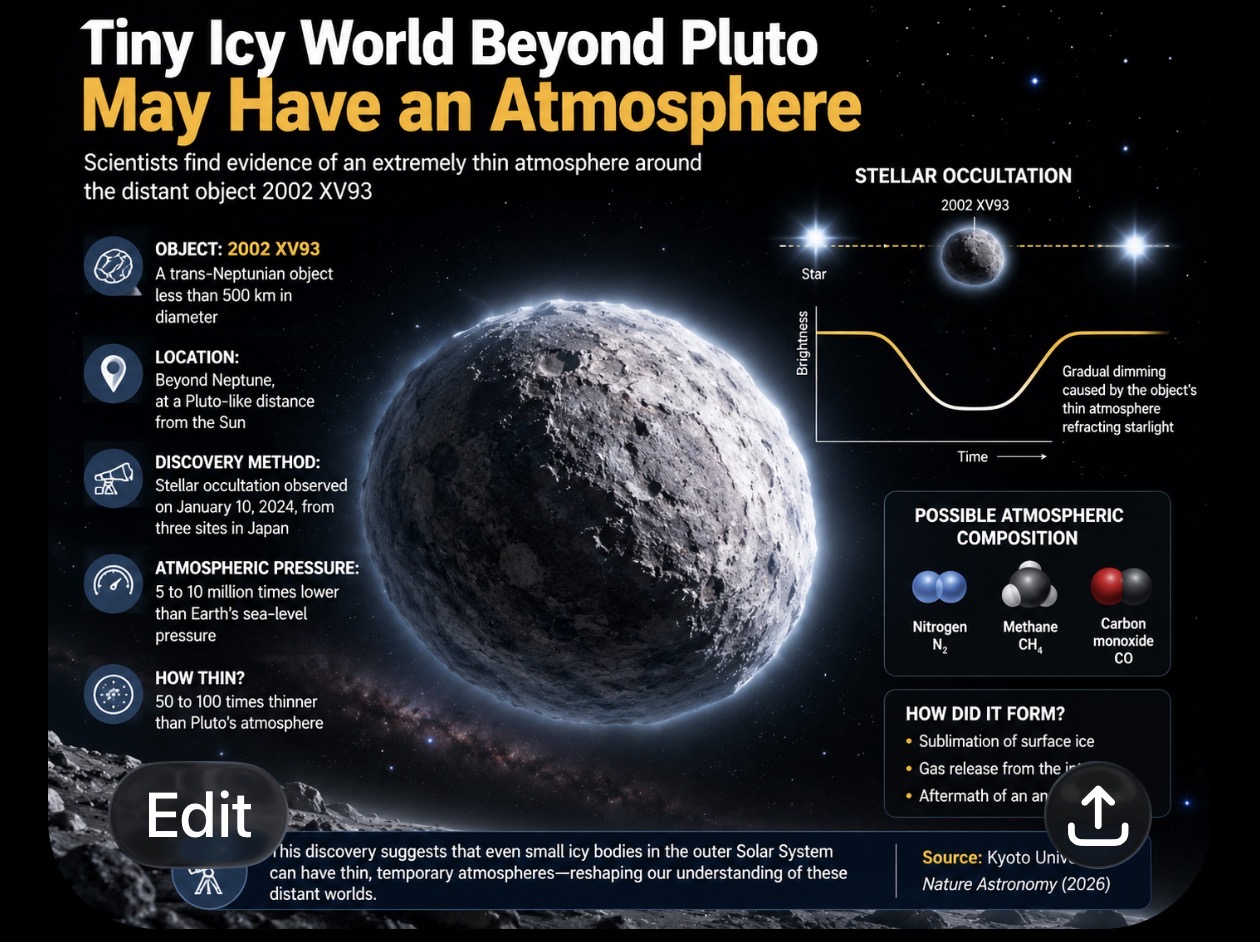
Astronomers have discovered compelling evidence that 2002 XV93, a small trans-Neptunian object located in the outer Solar System, is surrounded by an extremely thin atmosphere. Measuring less than 500 kilometers (310 miles) across, the icy body is much smaller than objects previously believed capable of maintaining even a tenuous gaseous envelope.
The discovery, reported by researchers from Kyoto University and published in Nature Astronomy (2026), suggests that some small icy worlds beyond Neptune may be far more dynamic than previously thought.
A Rare Stellar Event Revealed the Discovery
The breakthrough came during a stellar occultation on January 10, 2024, when 2002 XV93 passed directly in front of a distant star.
Instead of disappearing instantly behind the object, the star's light gradually dimmed before returning to normal brightness. Astronomers observed the event from three separate locations in Japan, allowing them to collect highly precise measurements.
According to the researchers, the gradual fading of the starlight is best explained by an extremely thin atmosphere surrounding the object. As the light passed through this gaseous layer, it was slightly bent—a phenomenon known as atmospheric refraction.
One of the Thinnest Atmospheres Ever Detected
Using detailed computer models, scientists estimate that the atmospheric pressure around 2002 XV93 is approximately 5 million to 10 million times lower than Earth's atmospheric pressure at sea level.
The atmosphere also appears to be 50 to 100 times thinner than Pluto's atmosphere, making it one of the faintest atmospheric detections ever reported for a Solar System body.
Although incredibly thin, the atmosphere is still capable of subtly altering the path of light during a stellar occultation, providing indirect but persuasive evidence of its existence.
What Is the Atmosphere Made Of?
Researchers have not yet identified the atmosphere's chemical composition.
However, three gases are considered the most likely candidates:
- Nitrogen (N₂)
- Methane (CH₄)
- Carbon monoxide (CO)
These volatile compounds are commonly found in the cold outer Solar System and can transition between solid ice and gas through sublimation, potentially creating a temporary atmosphere under suitable conditions.
Future observations will be required to determine which gas dominates and whether the atmosphere changes over time.
How Could Such a Small Object Have an Atmosphere?
The origin of the atmosphere remains one of the biggest mysteries.
Scientists are currently investigating several possible explanations, including slow sublimation of surface ice, episodic gas release from the object's interior, or gases produced following an ancient impact.
No single explanation has yet been confirmed, highlighting how little is known about the smallest icy bodies beyond Neptune.
Why the Discovery Matters
Planetary scientists have generally believed that only relatively large icy worlds, such as Pluto, could sustain detectable atmospheres.
The evidence from 2002 XV93 suggests that this assumption may need to be revised.
If future observations confirm the discovery, researchers may need to reconsider how common thin atmospheres are among small trans-Neptunian objects. Such findings could improve models of Solar System formation, volatile transport, and the long-term evolution of distant icy worlds.
The study also demonstrates the growing importance of stellar occultation observations, which continue to reveal properties of objects too small and too distant to study directly.
As more occultation events are observed with next-generation telescopes, astronomers may uncover additional small worlds with hidden atmospheres, offering new clues about one of the least explored regions of our Solar System.
Frequently Asked Questions (FAQ)
What is 2002 XV93?
2002 XV93 is a small trans-Neptunian object (TNO) that orbits the Sun beyond Neptune. It is an icy body less than 500 kilometers in diameter and resides in one of the coldest regions of the Solar System.
How did scientists detect its atmosphere?
Researchers observed a stellar occultation, in which 2002 XV93 passed in front of a distant star. The star's light dimmed gradually rather than disappearing abruptly, indicating that an extremely thin atmosphere refracted the starlight.
Does 2002 XV93 have an atmosphere like Earth's?
No. Its atmosphere is extraordinarily thin—estimated to be 5 million to 10 million times less dense than Earth's atmosphere and significantly thinner than Pluto's.
What gases might be present?
Scientists suspect the atmosphere could contain nitrogen, methane, or carbon monoxide, but its exact composition has not yet been confirmed.
Why is this discovery important?
The finding challenges existing theories about which Solar System objects can retain atmospheres. It suggests that even very small icy bodies may temporarily support thin gaseous envelopes, expanding our understanding of the outer Solar System.
Will scientists continue studying 2002 XV93?
Yes. Future stellar occultations, larger telescopes, and improved observational techniques are expected to help confirm the atmosphere, determine its composition, and explain how it formed.
Source: Kyoto University; Nature Astronomy (2026).