🔐 AI-Driven Cybersecurity Threats and Adaptive Defense Architectures in Modern Digital Systems
A structured review of modern cyber threats, defense architectures, and mitigation strategies — from AI-enhanced phishing and Ransomware-as-a-Service to Zero Trust Architecture and AI-based intrusion detection.
Abstract
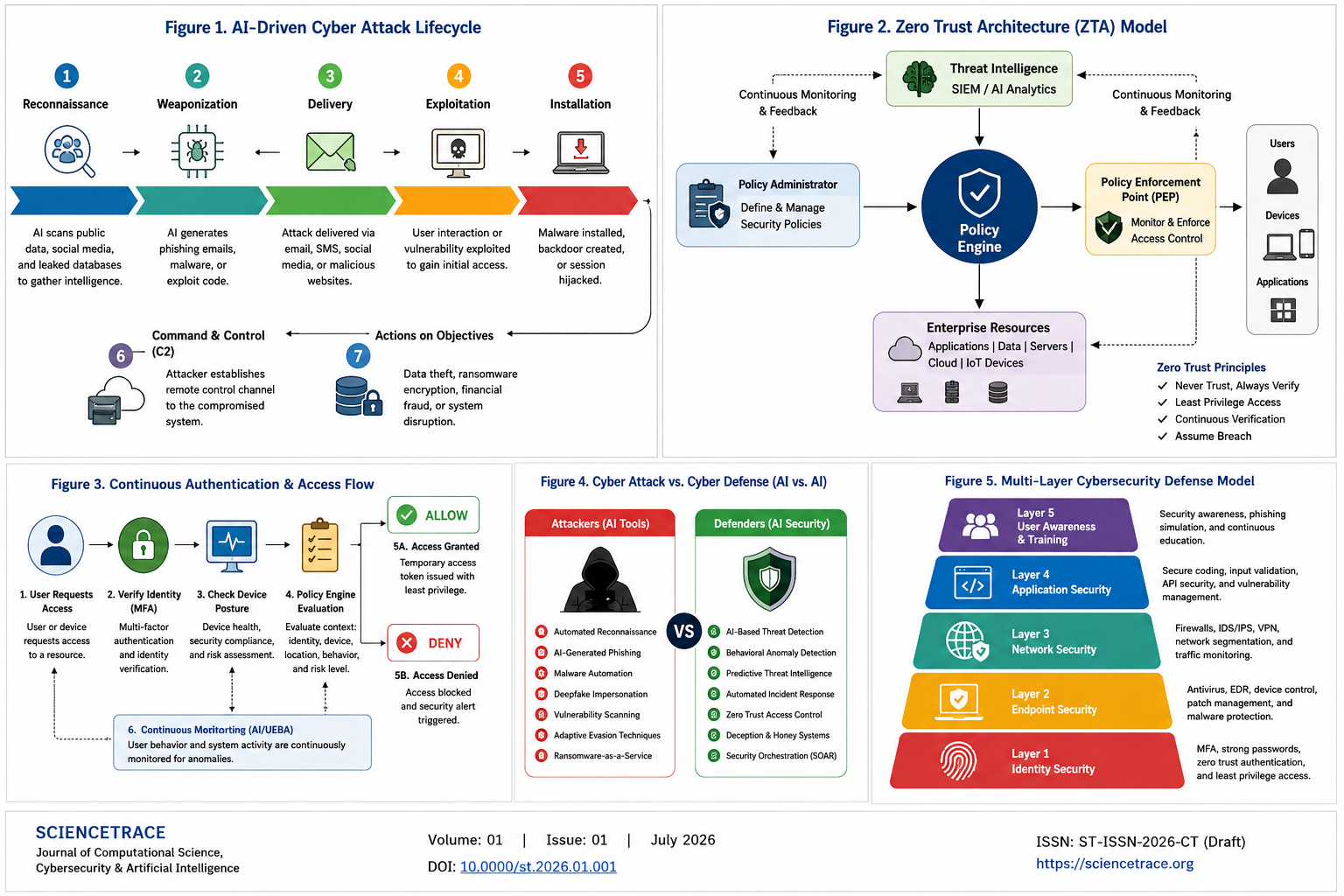
The rapid integration of artificial intelligence (AI), cloud computing, and interconnected digital ecosystems has fundamentally transformed the cybersecurity landscape. Cyber threats have evolved from static malware attacks into adaptive, autonomous, and AI-enhanced operations capable of scaling across global networks.
Simultaneously, cybersecurity defense mechanisms are also undergoing transformation through Zero Trust Architecture, machine learning-based intrusion detection systems, and continuous authentication frameworks. This paper presents a structured review of modern cyber threats, defense architectures, and mitigation strategies based on recent academic studies and global cybersecurity intelligence reports.
The findings indicate that while technological defenses are advancing, human behavior remains the most exploited vulnerability in modern cyber environments.
Keywords
Cybersecurity, Artificial Intelligence, Zero Trust Architecture, Phishing, Ransomware, Intrusion Detection Systems, Cloud Security, Threat Intelligence
1. Introduction
Cybersecurity has become a foundational requirement for modern digital infrastructure. As organizations increasingly rely on cloud services, mobile platforms, and interconnected systems, the attack surface for cybercriminals has expanded significantly.
Recent global cybersecurity reports highlight a sharp rise in AI-assisted cyberattacks, where automation is used to enhance reconnaissance, exploit vulnerabilities, and execute social engineering campaigns at scale. According to recent threat intelligence findings, AI-driven attacks are increasingly capable of adapting in real time, reducing the detection window available to defenders (ENISA Threat Landscape 2025).
This shift marks a transition from traditional reactive cybersecurity models to predictive, intelligence-driven security architectures.
2. Literature Review
2.1 AI in Cybersecurity Threat Evolution
Recent peer-reviewed studies confirm that artificial intelligence is now actively used in cybercrime ecosystems for phishing generation, malware automation, and deepfake-based social engineering attacks. AI enables attackers to create highly personalized and scalable intrusion strategies (arXiv: AI Cybersecurity Threats Survey).
These systems significantly increase attack success rates by improving linguistic accuracy and behavioral mimicry.
2.2 Global Threat Intelligence Reports
The ENISA Threat Landscape report identifies phishing and social engineering as the most common initial attack vectors, followed by vulnerability exploitation and ransomware campaigns (ENISA Report).
Recent cybersecurity statistics also show that AI-enhanced attacks now contribute to a significant portion of enterprise-level breaches, highlighting the growing role of automation in cybercrime.
2.3 Zero Trust Security Evolution
Zero Trust Architecture has emerged as a foundational cybersecurity model. According to NIST Special Publication 1800-35, Zero Trust is designed to secure distributed systems by continuously verifying identity, device integrity, and access context rather than trusting internal networks by default (NIST SP 1800-35).
3. Research Methodology
This study is based on qualitative secondary research using:
- Government cybersecurity frameworks (NIST, ENISA)
- Peer-reviewed academic papers (arXiv cybersecurity studies)
- Global cybersecurity threat intelligence reports
- Industry security analysis (AI-driven cyber risk reports)
Data was analyzed using thematic classification into:
- Cyber threat evolution
- Defense architecture models
- Prevention and mitigation strategies
4. Modern Cyber Threat Landscape
4.1 AI-Enhanced Phishing Attacks
Phishing remains the dominant cyber intrusion vector globally. However, modern phishing attacks are now AI-generated and highly personalized.
Characteristics include:
- Human-like email generation using generative AI
- Deepfake voice and video impersonation
- Context-aware social engineering using leaked data
- Real-time adaptive messaging systems
These techniques significantly reduce user detection capability.
4.2 Ransomware-as-a-Service (RaaS)
Ransomware has evolved into a structured cybercrime economy. Attackers now operate subscription-based ransomware platforms, allowing widespread deployment without technical expertise.
Key features:
- File encryption and system lockout
- Double extortion techniques (data theft + encryption)
- Cryptocurrency-based ransom payments
- Targeting of critical infrastructure sectors
4.3 AI-Powered Autonomous Attacks
AI systems are now capable of:
- Automated vulnerability scanning
- Credential stuffing at scale
- Adaptive malware evolution
- Real-time evasion of security systems
Recent studies indicate that AI significantly reduces attack execution time, enabling near-instant exploitation in some cases.
5. Cybersecurity Defense Frameworks
5.1 Zero Trust Architecture (ZTA)
Zero Trust operates on the principle: "Never trust, always verify."
Core principles:
- Continuous authentication
- Least privilege access control
- Micro-segmentation of networks
- Real-time behavioral monitoring
According to NIST, Zero Trust is essential for securing modern distributed cloud environments (NIST SP 1800-35).
5.2 AI-Based Intrusion Detection Systems
Modern cybersecurity systems use machine learning to detect anomalies in:
- Network traffic behavior
- User authentication patterns
- File system modifications
- API usage patterns
These systems enable predictive threat detection rather than reactive response.
5.3 Cloud and Endpoint Security
Cloud environments require advanced security models including:
- End-to-end encryption (data at rest and in transit)
- Identity and access management (IAM)
- Continuous API monitoring
- Automated compliance validation
Endpoints such as IoT devices and mobile systems remain major entry points for attackers.
6. Cybersecurity Prevention Strategies
6.1 Identity and Access Security
- Multi-factor authentication (MFA)
- Strong password policies
- Password managers
- Role-based access control
6.2 User-Level Protection
- Never share OTP, CVV, or banking credentials
- Avoid unknown links and attachments
- Verify domains before login
- Use official applications only
6.3 System-Level Protection
- Regular software patching
- Endpoint detection and response (EDR)
- Firewall configuration
- Malware protection systems
6.4 Network Security
- Avoid public Wi-Fi for sensitive operations
- Use encrypted VPN connections
- Monitor network traffic anomalies
6.5 Organizational Security Practices
- Cybersecurity awareness training
- Phishing simulation programs
- Incident response frameworks
- Least privilege enforcement
7. Human Factors in Cybersecurity
Despite technological advancements, human behavior remains the most exploited vulnerability in cybersecurity systems.
Common risk factors include:
- Weak password practices
- Social engineering susceptibility
- Emotional manipulation (fear, urgency)
- Overtrust in digital communication systems
Studies confirm that most cyber incidents originate from human interaction rather than system failure.
8. Emerging Cybersecurity Trends
8.1 Deepfake Cybercrime
AI-generated synthetic media is increasingly used for identity fraud and financial deception.
8.2 Supply Chain Attacks
Attackers exploit third-party vendors to infiltrate larger organizations.
8.3 Shadow AI Risks
Unauthorized use of AI tools within organizations increases data leakage risks.
8.4 Quantum Computing Threats
Future quantum systems may break traditional encryption, requiring post-quantum cryptography.
9. Discussion
Cybersecurity is evolving into an AI-versus-AI ecosystem where both attackers and defenders rely on machine intelligence. While defensive technologies are improving, attackers are simultaneously becoming more adaptive.
The most effective cybersecurity model is a layered defense strategy combining:
- AI-driven detection systems
- Zero Trust Architecture
- Continuous monitoring
- Human awareness and training
10. Conclusion
Cybersecurity is no longer a static technical discipline but a dynamic scientific field integrating artificial intelligence, cryptography, behavioral science, and systems engineering. As cyber threats become increasingly automated, defense systems must evolve toward predictive and adaptive models.
However, human behavior remains the most critical vulnerability. Strengthening cybersecurity awareness is therefore as important as technological innovation.
References
* ENISA Threat Landscape Report (2025)
https://www.enisa.europa.eu/publications/enisa-threat-landscape-2025
* NIST Special Publication 1800-35: Zero Trust Architecture (2025)
https://csrc.nist.gov/pubs/sp/1800/35/final
* AI-Driven Cybersecurity Threats: Survey (arXiv)
https://arxiv.org/abs/2601.03304
* AI Intrusion Detection Systems Study (arXiv)
https://arxiv.org/abs/2605.17219
* Global Cybersecurity Intelligence Reports (Industry Analysis)
https://www.reuters.com/world