Scientists Still Can't Explain This Quantum Mystery After 100 Years
More than a century after the birth of quantum mechanics, scientists still cannot agree on what it says about reality. Here is why the deepest question in physics remains unsolved.
The Strange Problem at the Heart of Modern Physics
Imagine a scientific theory so successful that it powers smartphones, lasers, MRI scanners, GPS satellites, and some of the world's most advanced computers.
Now imagine that the scientists who use this theory every day still cannot agree on what it actually says about reality.
That is the situation physics finds itself in today.
More than a century after the birth of quantum mechanics, researchers continue to debate one of the biggest unanswered questions in science: What is really happening in the quantum world?
The equations work. The experiments work. The technology works.
Yet the deeper meaning remains one of the greatest mysteries ever encountered by human beings.
Some physicists believe reality exists in multiple versions simultaneously. Others argue that hidden processes remain undiscovered. Still others suggest that our understanding of space, time, and information is fundamentally incomplete.
The result is a fascinating scientific puzzle that has survived for more than 100 years.
The Theory That Changed Everything
Before the twentieth century, scientists believed they were close to understanding the laws governing the universe.
Classical physics successfully explained planetary motion, gravity, electricity, and countless everyday phenomena. Many researchers assumed only a few minor details remained to be discovered.
Then the atomic world shattered those assumptions.
Experiments revealed that light behaved like both a wave and a particle. Electrons appeared to occupy multiple possibilities simultaneously. Atoms followed rules unlike anything observed in ordinary life.
To explain these discoveries, physicists developed quantum mechanics.
The theory transformed science.
Today, virtually every electronic device depends on principles first uncovered by quantum research. Modern chemistry, materials science, computing, and telecommunications all rely on quantum mechanics.
Yet from the beginning, scientists recognized a troubling reality.
The mathematics was clear.
The meaning was not.
The Universe of Possibilities
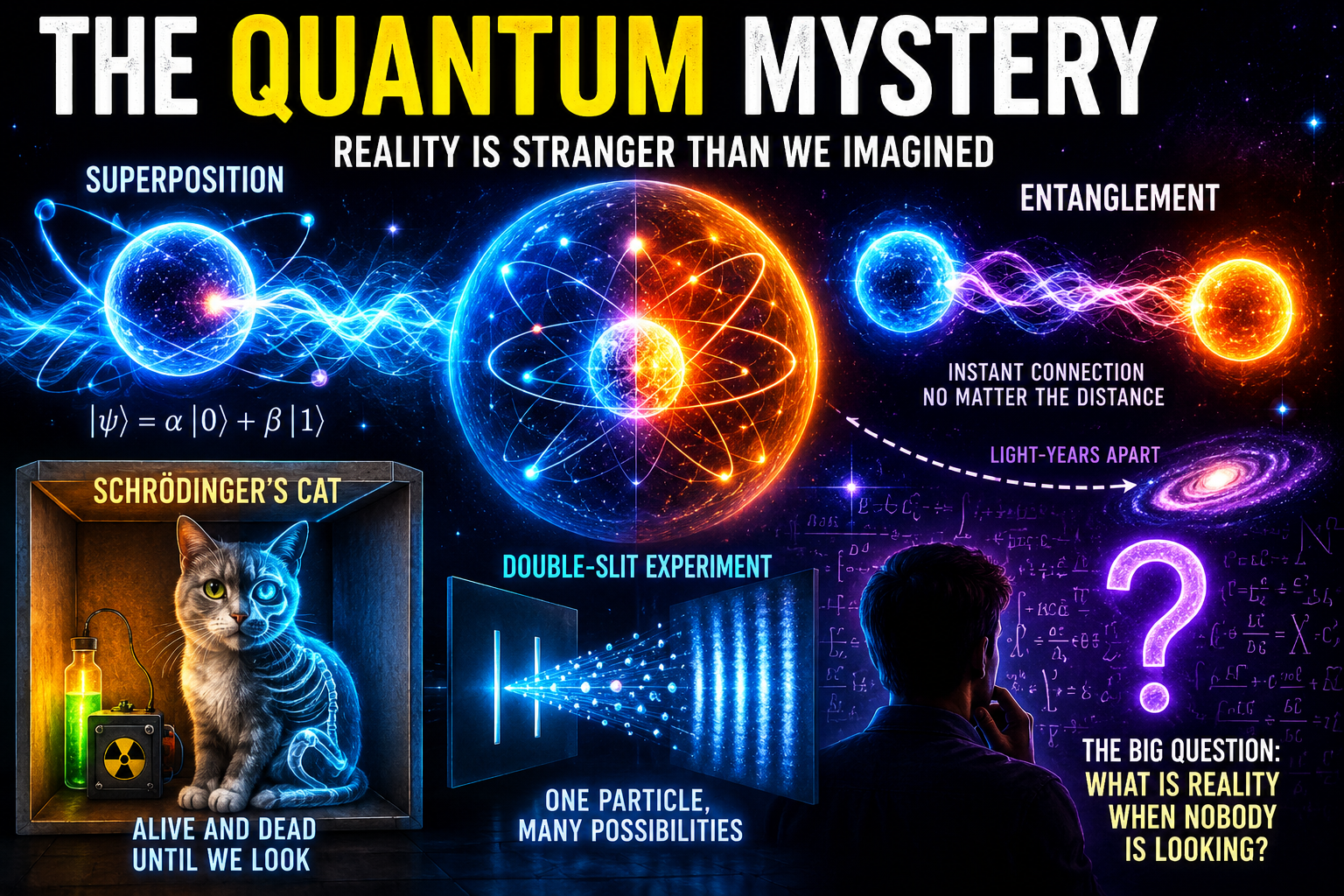
One of the strangest ideas in quantum physics is known as superposition.
In everyday life, objects appear to occupy a single state. A door is open or closed. A coin is heads or tails.
Quantum particles behave differently.
According to quantum theory, a particle can exist in multiple possible states simultaneously until a measurement occurs.
This does not simply mean we lack information about the particle. Experiments suggest the particle genuinely behaves as though several possibilities coexist at the same time.
The famous double-slit experiment demonstrates this mystery.
When electrons are fired toward a barrier containing two openings, they produce an interference pattern associated with waves rather than particles. It appears as though each electron somehow explores multiple paths before arriving at a final destination.
Physicists can calculate the outcome with extraordinary precision.
What remains unclear is what the particle is actually doing between measurements.
Schrödinger's Cat and the Question of Reality
In 1935, Austrian physicist Erwin Schrödinger proposed a thought experiment that became one of the most famous examples in scientific history.
Imagine a cat sealed inside a box.
The cat's survival depends on a random quantum event. If a radioactive atom decays, poison is released. If it does not decay, the cat survives.
According to a straightforward reading of quantum mechanics, the atom exists in a superposition before observation.
If the atom is both decayed and not decayed, what does that imply about the cat?
Schrödinger argued that the cat would appear to be both alive and dead until the box was opened.
His goal was not to suggest that cats actually exist in such states. Instead, he wanted to highlight the bizarre implications of quantum theory.
Nearly a century later, physicists still debate what the thought experiment reveals about reality.
Einstein's Greatest Objection
Albert Einstein accepted that quantum mechanics produced accurate predictions.
What he rejected was the idea that reality itself might be fundamentally uncertain.
He famously stated that "God does not play dice."
Einstein believed that hidden information must exist beneath quantum behavior.
His skepticism intensified when physicists proposed entanglement.
Entanglement occurs when two particles become linked in such a way that measuring one instantly reveals information about the other, regardless of distance.
Einstein referred to this phenomenon as "spooky action at a distance."
For decades, scientists debated whether entanglement represented a genuine feature of nature or an incomplete understanding of physics.
Modern experiments have overwhelmingly supported the reality of entanglement.
The mystery remains. How nature creates these correlations continues to challenge intuition.
The Measurement Problem
At the center of the quantum mystery lies a question known as the measurement problem.
Quantum equations describe probabilities. Before observation, multiple outcomes appear possible. After observation, only one outcome exists.
Why?
What causes the transition from possibility to reality?
What exactly qualifies as a measurement?
Scientists have proposed many answers, but no explanation has achieved universal acceptance.
Some interpretations suggest that wavefunctions physically collapse during measurement. Others argue that all possible outcomes continue to exist in separate branches of reality. Still others propose entirely new physical mechanisms that have not yet been discovered.
The fact that multiple competing explanations survive today demonstrates how profound the mystery remains.
Why This Mystery Matters Today
Quantum mysteries are no longer confined to philosophy and theoretical physics.
They are becoming increasingly important to technology.
Governments and technology companies are investing billions of dollars into quantum computing research. Scientists are developing quantum communication networks and advanced sensors capable of extraordinary precision.
Artificial intelligence is also helping researchers analyze complex quantum systems and discover patterns that would otherwise remain hidden.
Understanding quantum reality may influence the future of computing, medicine, materials science, and global communications.
In other words, solving the quantum mystery could reshape the modern world.
Could Quantum Physics Explain the Universe?
Many scientists suspect that quantum mechanics may be even more fundamental than previously imagined.
Some theories suggest that spacetime itself emerges from quantum information. Others propose that black holes hold clues to the relationship between information and reality.
A growing number of researchers believe that understanding quantum information could ultimately help explain the origins of the universe.
If these ideas prove correct, quantum mechanics may represent more than a theory of particles.
It may be a theory of reality itself.
Conclusion
Quantum mechanics has survived every major experimental challenge for more than a century.
Its predictions power modern technology and continue to shape scientific progress.
Yet its deepest meaning remains unresolved.
Particles appear to exist in multiple states simultaneously. Entangled objects maintain mysterious connections across vast distances. Measurements transform possibilities into outcomes in ways that scientists still struggle to explain.
The greatest mystery is not that quantum mechanics works.
The greatest mystery is that after more than 100 years of study, humanity still does not fully understand why.
Frequently Asked Questions
What is the biggest quantum mystery?
Most physicists consider the measurement problem one of the biggest mysteries because nobody fully understands how quantum possibilities become definite outcomes.
Why is quantum physics so strange?
Quantum physics describes a microscopic world that behaves very differently from everyday experience, including phenomena such as superposition and entanglement.
Is Schrödinger's cat real?
No. It is a thought experiment designed to illustrate conceptual challenges within quantum mechanics.
Why is quantum computing important?
Quantum computers could solve certain scientific and technological problems much faster than traditional computers.
Could quantum mechanics explain reality?
Many researchers believe quantum theory may eventually help explain spacetime, gravity, information, and the origins of the universe.