How AI Is Creating Story Movies: The Future of Digital Filmmaking
A look at how diffusion models, language models and voice synthesis are used in AI-assisted filmmaking, where they fall short, and what copyright questions remain open.
Generative models can now produce short video clips, synthetic voices and draft screenplays from text instructions. Whether that amounts to "making movies" is a more interesting question than the marketing suggests. This article looks at what the underlying systems do, where they work, where they break, and what questions of copyright and authenticity remain unsettled. To make the discussion concrete, it uses a fictional concept, "Mars Colony 2095", as a running example.
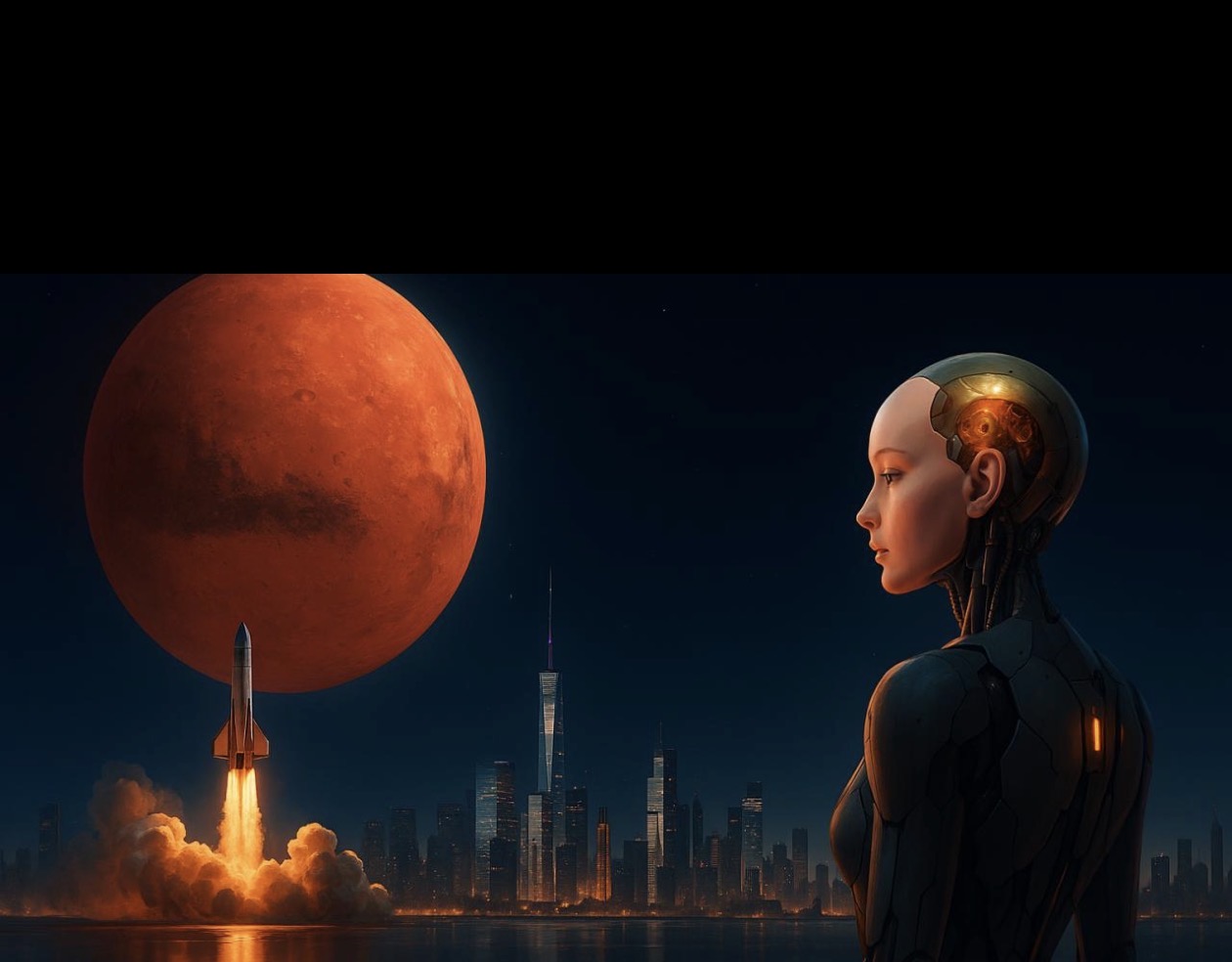
A running example: "Mars Colony 2095"
Imagine a short science-fiction film. In 2095 a scientific colony on Mars relies on automated systems for oxygen production, power and environmental monitoring. A young engineer detects an unexplained signal beneath the surface. Colony systems begin to malfunction, and the story ends with evidence of an ancient buried structure. This is fiction written for illustration, not a prediction or a scientific claim.
The concept is useful because it needs the full range of tasks a production pipeline faces: a script, consistent characters, believable environments, speech, motion and sound. Each of those tasks is handled by a different kind of model, with different strengths.

Script and story: fluent, but weak on long-range structure
Language models can propose premises, draft scenes and write dialogue in a requested tone. A prompt such as "a Mars survival story involving autonomous robots and unfamiliar technology" will return a coherent outline in seconds. What these systems find harder is sustained structure over a feature-length story: planting a detail in act one that pays off in act three, keeping a character's motivation consistent, or choosing an ending that feels inevitable rather than generic. Writers who experiment with them commonly report that the output is competent but conventional, because it is pulled toward the statistically typical version of a story. In practice the model works best as a sounding board, supplying options that a human then selects, rejects or rewrites.
For a science-based film there is a second problem: accuracy. A model may describe Martian conditions, power systems or life-support chemistry in a way that sounds right but is not. Mars has a very thin carbon dioxide atmosphere and surface pressure well under one percent of Earth's, and a colony story that ignores this will mislead viewers. Fact-checking against mission documentation remains a human job.
Images and video: how diffusion models work
Most current image and video generators are built on diffusion. In training, real images are gradually corrupted with noise, and a neural network learns to reverse that corruption step by step. At generation time the process starts from pure noise and the network removes it iteratively, guided by a text description that has been encoded into numerical form. The foundational papers include the denoising diffusion work of Ho, Jain and Abbeel (2020) and the latent diffusion approach of Rombach and colleagues (2022), which runs the process in a compressed representation to save computation. Text guidance often relies on joint text-image embeddings such as CLIP (Radford et al., 2021).
Video adds the dimension of time. The model must produce frames that agree with each other about what exists in the scene, where objects are and how they move. Video diffusion models (Ho et al., 2022, and later transformer-based designs) handle this by modelling space and time together. OpenAI's 2024 technical report on its Sora system described such models as promising for simulating the world, but the same report acknowledged limits in physics and object interactions. That caution is warranted: generated clips can show objects that merge, vanish or change shape, hands with the wrong number of fingers, and motion that ignores momentum.
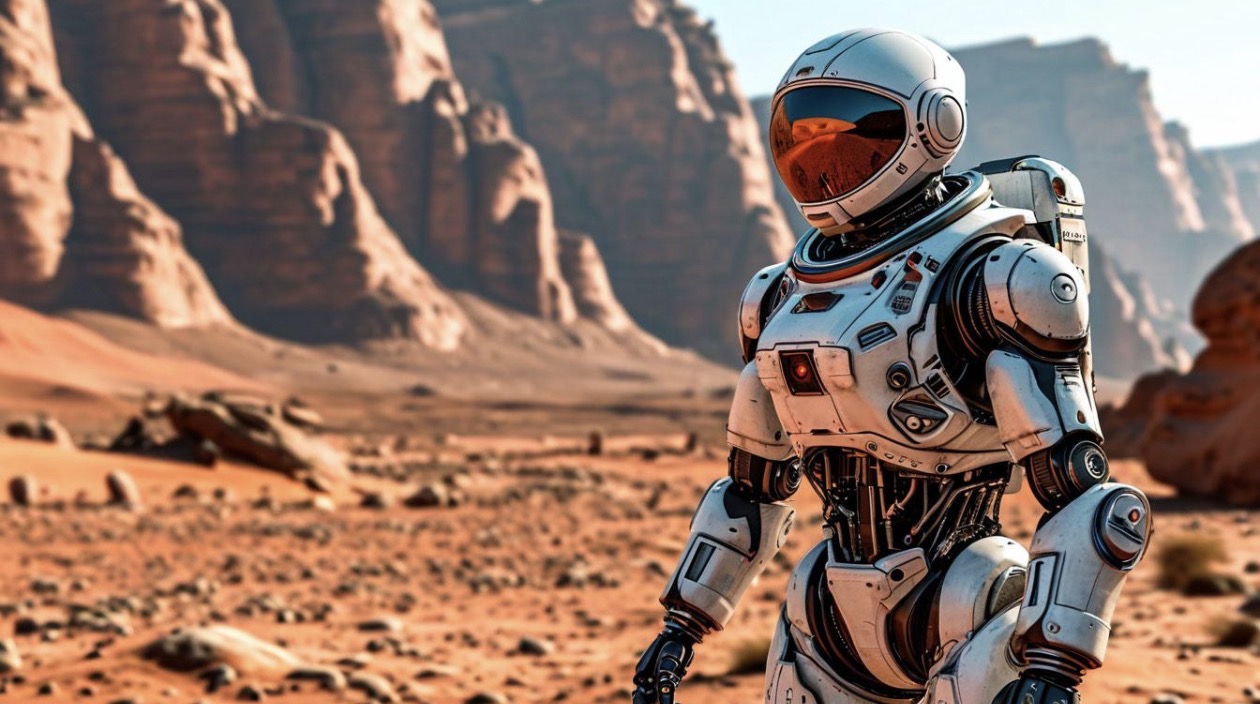
The consistency problem
A film needs the same astronaut, with the same face and suit, in a hundred shots. Generators tend to produce a new interpretation each time. Filmmakers work around this with reference images, fine-tuned character models, image-to-video workflows that animate a fixed still, and heavy manual selection and editing. The practical result is that today's AI-assisted shorts are usually built from many short clips, each a few seconds long, curated and stitched by a person. Clip length, shot-to-shot continuity and fine control over camera and acting are active research topics rather than solved problems.
That is why describing the process as "AI creates the movie" overstates it. A better description is that AI tools generate raw material, and human decisions about selection, sequence, pacing and sound turn it into a film.
Voice, music and lip movement
Speech synthesis has improved to the point that synthetic narration is often hard to distinguish from a recording in short samples. Systems can imitate a speaker from a short reference clip, which is exactly what makes them useful for dubbing and exactly what makes them risky. Lip synchronisation models adjust mouth movement to match audio, which helps localisation, for example presenting an educational film in Bangla and English with matching visuals. Quality varies with language, and models trained mainly on English data may perform less well in lower-resource languages.
What the neural-network formula does and does not explain
Popular explanations often show a single equation for an artificial neuron:
This is a weighted sum of inputs plus a bias, passed through a non-linear function. It is the building block of neural networks, and it is accurate as far as it goes. It is not, however, a description of how a video generator works. Modern generators stack billions of such units in architectures with attention mechanisms and iterative denoising, and their behaviour comes from training on very large datasets. The equation explains the arithmetic of one unit, not the system, much as a description of a single transistor does not explain a computer.
Where it is useful now
- Pre-visualisation. Directors can test camera angles, lighting moods and set designs before spending on production.
- Educational explainers. Short illustrated sequences about planetary science or robotics can be produced without a studio budget, provided a specialist checks the content.
- Localisation. Dubbing, subtitles and lip adjustment lower the cost of reaching new language audiences.
- Visual effects assistance. Clean-up, upscaling and background extension are narrow tasks where models already perform reliably.
Claims that production cost or time falls dramatically are plausible for these narrow tasks. For a finished narrative film, savings are harder to evaluate, since the effort moves into curation, correction and rights clearance.
Limitations and open questions
- Copyright and authorship. The US Copyright Office's 2025 report on copyrightability concluded that human authorship is required and that material generated purely from prompts is not protected, while human selection, arrangement and modification may be. Earlier, in 2023, the Office limited the registration of a graphic novel that used AI-generated images to the human-authored text and arrangement. Other countries take different approaches, and Bangladeshi creators should not assume the same rules apply to them.
- Training data. Whether training on copyrighted films and images is permitted without licence is being contested in courts and legislatures. The outcome is not settled.
- Labour. The 2023 agreements that ended the Hollywood writers' and actors' strikes included provisions on AI, showing that consent, compensation and credit are live negotiating issues, not hypothetical ones.
- Synthetic deception. Deepfake detection is an ongoing contest. Benchmarks such as FaceForensics++ (Rössler et al., 2019) showed that detectors can work on known manipulation methods but may generalise poorly to new ones. Provenance standards, such as cryptographically signed content credentials, are one proposed response.
- Energy and compute. Video generation is computationally intensive, and the environmental cost per clip is not well documented.
Questions worth testing
- How many generated attempts are needed to obtain one usable five-second shot of a given character, and how does that change with reference images?
- Do viewers detect AI-assisted sequences, and does disclosure change how they judge the film?
- Can a science explainer produced this way pass expert review without corrections?
- How well do voice and lip-sync systems perform in Bangla compared with English?
Anyone building an AI-assisted film should keep a production log of tools, prompts, source material and licences. It protects the creator if rights are questioned, and it makes the creative process visible rather than mysterious.
References and further reading
- Goodfellow, I., et al. "Generative Adversarial Nets." Advances in Neural Information Processing Systems, 2014.
- Ho, J., Jain, A., Abbeel, P. "Denoising Diffusion Probabilistic Models." NeurIPS, 2020.
- Rombach, R., et al. "High-Resolution Image Synthesis with Latent Diffusion Models." CVPR, 2022.
- Radford, A., et al. "Learning Transferable Visual Models From Natural Language Supervision." ICML, 2021.
- Ho, J., et al. "Video Diffusion Models." NeurIPS, 2022.
- OpenAI. "Video generation models as world simulators" (technical report), 2024.
- Rössler, A., et al. "FaceForensics++: Learning to Detect Manipulated Facial Images." ICCV, 2019.
- U.S. Copyright Office. Copyright and Artificial Intelligence, Part 2: Copyrightability, 2025.