Ghostly Cat's Head Nebula Revealed in New Hubble and Webb Views
How two space telescopes are exposing the hidden structures of a stellar nursery inside the Carina Nebula, about 7,500 light-years from Earth.
A dark, elongated shape that looks like a cat sitting with its back to the viewer has appeared in a new pair of astronomical images. Nicknamed the Cat's Head Nebula, it sits inside the much larger Carina Nebula, a region of gas and dust where new stars are forming.
NASA's Hubble Space Telescope and the James Webb Space Telescope observed the same patch of sky in different kinds of light. The images, released on October 29, 2026, show details that neither telescope could reveal alone. The region lies roughly 7,500 light-years from Earth, according to NASA and the European Space Agency.
A Shape That Is Only a Coincidence
The nickname comes from the outline of a dense pillar of dust. Its narrow body runs through the frame, and its upper part bends to the right to suggest a head. A bright spot near the top even looks like an eye.
The resemblance is pure chance. What we are looking at is interstellar gas and dust being shaped by the intense environment around it.
Inside the Carina Nebula
The Carina Nebula is a large, active star-forming region in the southern constellation Carina. It contains massive, hot stars that release powerful ultraviolet radiation and fast streams of charged particles called stellar winds.
That energy heats and pushes on nearby clouds. It can compress gas and help new stars begin to form, but it can also strip material away before that happens. The Cat's Head pillar is therefore a temporary structure: thinner gas is swept away quickly, while denser pockets resist erosion for longer. The image captures one moment in an ongoing process, not a permanent sculpture.
How the Pillar Got Its Outline
NASA and ESA explain that the shape was most likely carved by ultraviolet light and winds from massive stars across the wider nebula. Astronomers call this stellar feedback: the energy of existing stars shapes the material from which later stars may be born.
When ultraviolet light heats the surface of a cloud and gas boils off, the process is known as photoevaporation. A bright rim along the right-hand edge of the pillar is consistent with gas being lit up and ionised by nearby massive stars. Meanwhile the dense interior stays dark because dust absorbs and scatters visible light.
Hubble's Visible-Light View
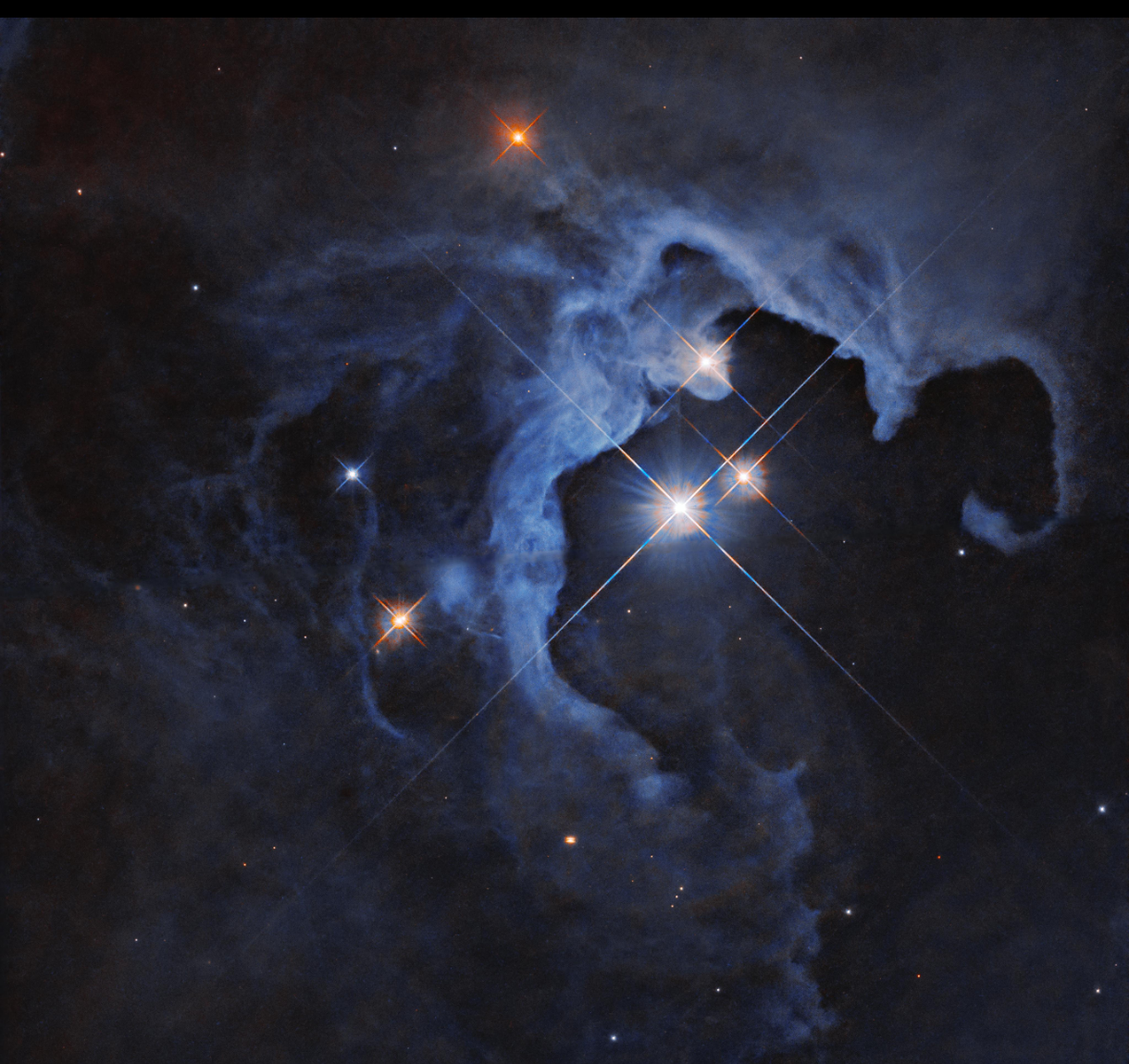
In Hubble's image the Cat's Head appears as a dark brown pillar, its dust blocking much of the light from objects behind it. A glowing red feature near the head may be a young star still partly buried in dust. The wording matters here: the image points to a possible young star, but appearance alone cannot confirm its nature.
Hubble's filters pick out light from oxygen, hydrogen and sulfur, along with starlight scattered by dust. The colours in the final picture are chosen to make these differences visible. They are not necessarily what a person would see with the unaided eye.
Webb Looks Through the Dust
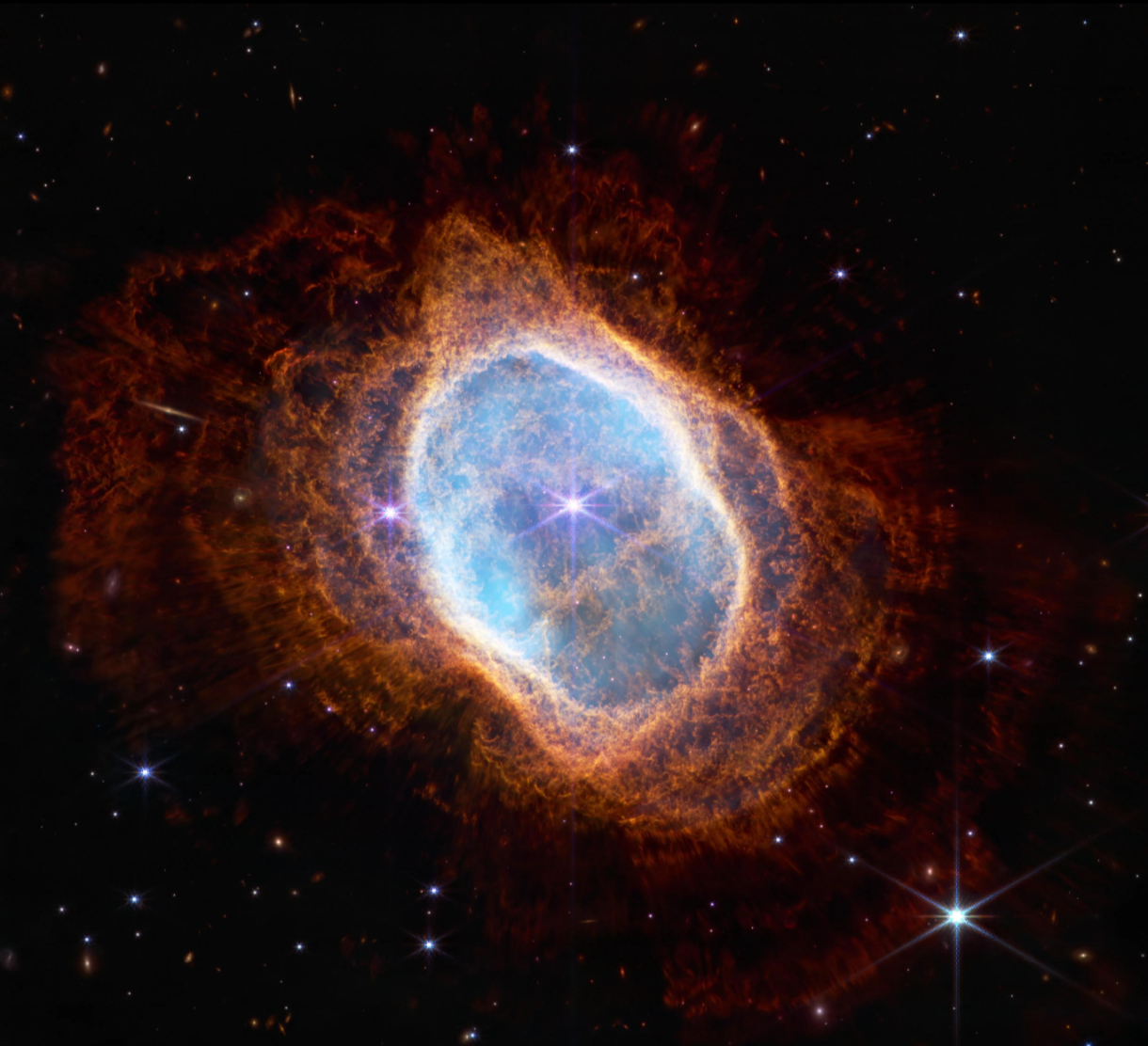
Webb observes in infrared light, and some infrared wavelengths pass through dust much more easily than visible light. In its near-infrared image the central pillar is still recognisable but looks more detailed, with wispy strands of gas and dust to its left. The field is crowded with stars, some still partly hidden, and even faint background galaxies show through, a reminder that the telescope is looking past our own galaxy toward far more distant objects.
Webb's mid-infrared view adds another layer. Warm dust and carbon-based molecules glow at these wavelengths, tracing fine globules and filaments around the pillar. A bright yellow source on the right is probably an infant star embedded in dust, although the image alone cannot show whether a thin filament crossing it is physically connected.
What Astronomers Can Learn
Each wavelength reveals different temperatures, chemical signatures and levels of dust cover. Visible light shows where dust blocks the background and where energised atoms glow. Near-infrared light exposes stars behind some of the dust. Mid-infrared light traces warm dust and molecules.
Comparing them lets researchers study how radiation travels through a cloud, where gas is being heated, and how dense structures survive in such a harsh setting. It also speaks to a central question of star formation: when massive neighbours both squeeze and erode their birth clouds, which effect wins? The answer depends on density, geometry and radiation strength, and these observations do not settle every question about the region's history.
Why Hubble and Webb Work Better Together
The two observatories are not rivals. Hubble is well suited to mapping glowing gas, dust lanes and the boundary between bright and dark regions. Webb's infrared instruments reveal cooler and more deeply embedded material.
Visible light alone would leave the pillar looking largely opaque, with many stars hidden. Infrared alone would lose some of the contrast that makes the illuminated edge and dark silhouette so clear. The two views are not the same photograph in different colours; they are measurements of different kinds of light, each showing a different side of the same structure.
A Snapshot of a Stellar Nursery
The Cat's Head is a reminder that a familiar shape can come from processes far beyond everyday experience. The animal-like silhouette is really gas and dust responding to gravity, radiation and stellar winds, and its "eye" may be a young star hidden in its birth cloud.
At about 7,500 light-years away, the region is far out of reach, yet its light carries enough information for telescopes to reconstruct part of its story. Radiation and winds will keep reshaping the pillar, and its dense material may eventually disperse or help form new stars. For now, Hubble and Webb have captured a revealing snapshot of a stellar nursery in motion.
Image credit: NASA, ESA, CSA, STScI; image processing: Joseph DePasquale (STScI).
Sources: NASA Science, "Ghostly Cat's Head Nebula Lurks Within Sight of NASA's Hubble, Webb" (October 29, 2026); ESA/Hubble, "Ghostly Cat's Head Nebula lurks within sight of Hubble and Webb" (October 29, 2026). Interpretations the agencies describe as "may," "likely" or "consistent with" are presented here as provisional, not confirmed discoveries.