What Happens When You Fall Into a Black Hole?
A scientific journey beyond the event horizon: what an astronaut would see, feel and experience while falling into a black hole.
Introduction: A Journey Toward the Unknown
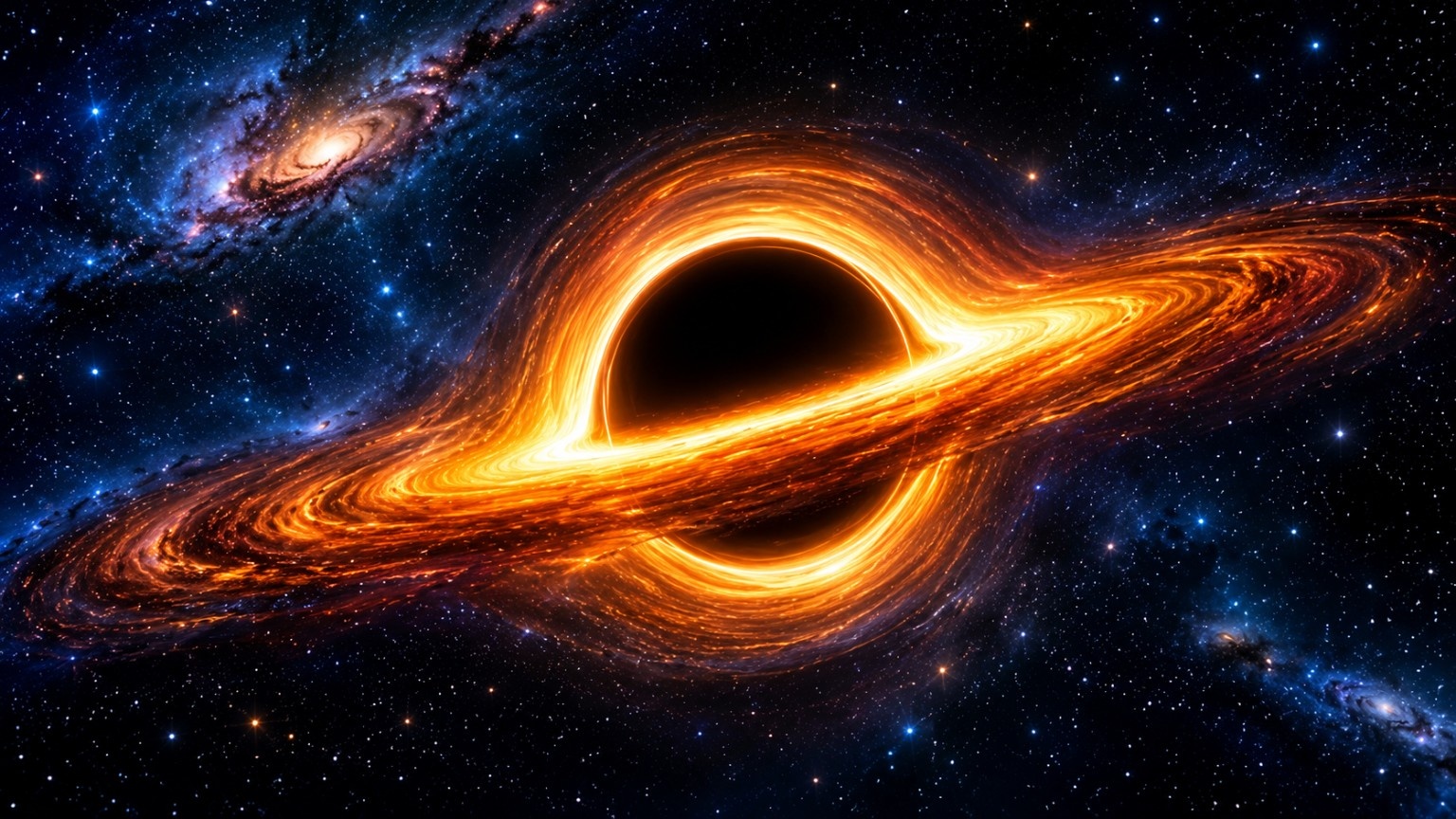
Imagine looking out of a spacecraft window and seeing a region of space so dark that even the brightest beam of light cannot return from it. Around that darkness, stars appear strangely distorted. A glowing ring of superheated gas circles an invisible centre, while the fabric of space and time itself is pushed into an extreme curve.
You are approaching a black hole—one of the most fascinating objects predicted by modern physics. The question “What happens when you fall into a black hole?” sounds like science fiction, but it is a serious scientific question. Physicists use Einstein’s general theory of relativity to calculate how gravity affects space, time, light and matter near these objects.
The results are extraordinary.
1. What Exactly Is a Black Hole?
A black hole is a region of space where matter has been compressed so intensely that gravity creates a boundary beyond which nothing can escape to the distant universe—not even light. The boundary is known as the event horizon. It is not a solid surface, wall or shell.
It is a limit in spacetime: once an object crosses it, every possible future path leads farther inward. Black holes are not empty holes in space, nor are they cosmic vacuum cleaners that automatically pull in everything nearby. At a sufficient distance, the gravitational influence of a black hole is like that of any other object with the same mass.
If the Sun could somehow be replaced by a black hole with exactly the same mass, Earth would continue along almost the same orbit.
2. How Do Black Holes Form?
One well-established pathway begins with a massive star. For most of its life, a star balances the inward pull of gravity against outward pressure produced by energy from nuclear fusion in its core. When a sufficiently massive star can no longer support itself, its core may collapse.
Depending on the star’s mass and the details of its evolution, the collapse can leave behind a black hole. Some stellar collapses are associated with supernova explosions; others may produce a black hole with a less spectacular outward display. Black holes can also grow.
Gas, dust and even stars can be drawn into their gravitational influence. When material spirals inward, it may form an accretion disk: a flattened structure of gas and debris orbiting the black hole. Friction, turbulence and magnetic processes heat the material to extreme temperatures.
3. The First View: A Strange and Distorted Universe
As your spacecraft approaches a black hole, the view outside would become increasingly unusual. The black hole’s gravity bends the paths of light travelling nearby. This effect is called gravitational lensing.
Light from stars behind the black hole can be redirected, stretched into arcs or appear in multiple distorted images. The black hole may seem to occupy a much larger portion of the sky than its dark central region would suggest. You would not necessarily see a simple black circle surrounded by a neat glowing ring.
The appearance depends on the black hole’s spin, the position of the observer, the distribution of gas and the paths followed by light. Light from the far side of an accretion disk can be bent around the black hole and become visible above or below the dark central shadow.
4. The Accretion Disk: The Dangerous Neighbourhood
The black hole itself is not necessarily the brightest or most immediately destructive part of the journey. The region around an actively feeding black hole can be filled with high-energy radiation and rapidly moving material. Gas in an accretion disk can become so hot that it emits ultraviolet light and X-rays.
Some systems also launch powerful jets of particles along directions close to the black hole’s rotation axis. A spacecraft passing through a dense, luminous accretion environment could face intense radiation, extreme heat and impacts from energetic particles. These hazards could destroy an unprotected spacecraft long before it reached the event horizon.
A quiet black hole with little surrounding gas would present a very different external environment. The disk is not a solid ring and does not simply sit motionless around the black hole.
5. The Event Horizon: The Point of No Return
The event horizon is the most important boundary in the journey. It marks the region from which no signal can escape to distant observers. In a simple description, the escape speed at this boundary reaches the speed of light.
Since nothing can travel faster than light, a spacecraft that crosses the horizon cannot return to the outside universe. It is important not to imagine the event horizon as a physical shell that an astronaut would strike. In the idealised case of a sufficiently large black hole, crossing the horizon may not produce a sudden flash, impact or visible barrier at that exact moment.
The astronaut’s local experience could be uneventful at the crossing, even though the global consequence is irreversible: every future route through spacetime leads inward.
6. What Is Spaghettification?
As you move closer to a black hole, gravity does not pull equally on every part of your body. The side nearer the black hole experiences a stronger gravitational acceleration than the side farther away. This difference is called a tidal force.
On Earth, tidal forces from the Moon help produce ocean tides. Near a black hole, the same basic effect can become overwhelmingly powerful. If the difference is strong enough, an object is stretched along the direction toward the black hole and compressed in other directions.
Scientists and science communicators call this process spaghettification because an object can be elongated into a thin shape like a strand of spaghetti. For a stellar-mass black hole, the tidal forces can become fatal well outside the event horizon.
7. Time Dilation: Why Clocks Disagree
One of the most remarkable predictions of Einstein’s general theory of relativity is that gravity affects the passage of time. A clock close to a massive object, when compared with a clock far away, can tick more slowly. This effect is known as gravitational time dilation.
It has been measured in weaker gravitational fields and must be considered in technologies such as satellite navigation. Near a black hole, the difference can become extreme. Imagine two observers: one remains far away, while the other falls toward the event horizon.
The distant observer receives signals from the falling astronaut that become increasingly delayed, weakened and redshifted. The astronaut’s clock appears to run more and more slowly in the distant observer’s view. The light carrying the image also loses energy, becoming dimmer and shifting toward longer wavelengths.
8. What Would You Experience After Crossing?
After crossing the event horizon, the astronaut cannot turn around and escape. In the simplest non-rotating black-hole model, moving toward smaller radius becomes as unavoidable as moving toward the future. The centre is no longer a destination that can be avoided by choosing a different direction.
Every future-directed path leads deeper inward. The astronaut may still receive light from parts of the outside universe for a time, depending on the trajectory and spacetime geometry. But sending a signal outward is impossible.
A radio message, laser pulse or distress beacon cannot cross the horizon from inside and reach a distant receiver. The barrier is not a weakness in the transmitter; it is a consequence of the structure of spacetime. The journey from the horizon to the deep interior is not necessarily long.
9. The Singularity: Where Current Physics Reaches Its Limit
In the classical mathematical description of a simple black hole, matter collapses toward a central singularity. In that model, density and spacetime curvature become infinite, signalling that general relativity is no longer giving a complete physical description. A singularity is therefore not simply a tiny solid object at the centre.
It is a warning that the classical theory has reached a limit. Physicists expect that a more complete theory combining gravity with quantum physics will be needed to describe the deepest interior. General relativity is extraordinarily successful at explaining gravity on large scales, while quantum theory describes matter and forces at very small scales.
A black-hole singularity brings these domains together under conditions where neither theory, used alone in its familiar form, provides a final answer.
10. Do All Black Holes Spin?
Many astrophysical black holes are expected to rotate because the stars and gas from which they form carry angular momentum. A rotating black hole is described, in the idealised solution of general relativity, by the Kerr geometry. Rotation changes the structure of spacetime around the object and introduces effects that do not appear in the simplest non-rotating model.
One important effect is frame dragging. A rotating mass twists nearby spacetime, influencing the motion of objects and even the paths of light. Close to a rotating black hole, this effect can become very strong.
There is also an outer region called the ergosphere, where spacetime is dragged around so strongly that an object cannot remain stationary relative to distant stars.
11. Can Anything Escape a Black Hole?
The defining feature of an event horizon is that no signal from inside it can reach distant observers. This includes light, radio waves and any ordinary material object. The statement does not mean that black holes exert an unlimited gravitational pull at every distance.
It means that inside the horizon, the geometry of spacetime leaves no outward path that can carry a signal to the outside. Powerful jets sometimes seen near black holes do not emerge from inside the event horizon. They are produced by processes involving matter and magnetic fields in the environment outside the horizon.
The black hole’s rotation may help power these jets, but the observed material is launched from the surrounding region, not from a point deep within the black hole. There is also a theoretical prediction known as Hawking radiation.
12. How Do Scientists Study These Invisible Objects?
Because black holes do not emit light from within their event horizons, astronomers study them through their influence on the universe around them. One method is to observe stars orbiting an unseen massive object. By measuring the stars’ positions and speeds, researchers can estimate the mass concentrated in the region.
At the centre of the Milky Way, stars orbit a compact object known as Sagittarius A*. Their motion provides strong evidence for a supermassive black hole. Another method is to observe hot gas near a black hole.
As material falls inward, it can heat up and emit X-rays and other radiation. Space telescopes can measure changes in this emission, helping researchers investigate the behaviour of matter in extreme gravity. The bright regions around some supermassive black holes can be detected across enormous cosmic distances.
13. Could a Human Ever Visit a Black Hole?
A crewed mission to a black hole is far beyond present technology. The nearest known black-hole candidates are still extraordinarily distant on human travel scales. Reaching one would require immense travel time and energy, along with a spacecraft capable of protecting its crew from radiation, particles and the challenges of long-duration spaceflight.
Even if a spacecraft could reach a quiet black hole, a safe return mission would be impossible if it crossed the event horizon. A practical scientific mission would therefore need to remain at a safe distance, observe the black hole and its surroundings, and transmit data before any danger became unavoidable. Robotic probes could potentially make measurements in the surrounding environment, but they would still face navigation and communication challenges.
Conclusion: A Boundary Between the Known and Unknown
Falling into a black hole would be a journey unlike any other. Before reaching the event horizon, an astronaut might see a distorted sky, unusual images of stars and a brilliant accretion disk if gas surrounded the black hole. Depending on its mass, tidal forces could destroy the spacecraft or astronaut before the horizon—or might remain relatively mild at the crossing of a supermassive black hole.
Time would be measured differently by the falling traveller and a distant observer. After the event horizon is crossed, there is no route back to the outside universe. The astronaut cannot send a final message outward, and the journey continues toward a region where classical physics predicts a singularity.
Further Reading
- NASA — Black Holes: https://science.nasa.gov/universe/black-holes/
- Event Horizon Telescope: https://eventhorizontelescope.org/
- LIGO Laboratory: https://www.ligo.caltech.edu/
- European Space Agency: https://www.esa.int/