Voyager 1: One Light-Day from Earth — When a Message Takes 24 Hours to Reach Humanity’s Farthest Spacecraft
Imagine sending a message to a spacecraft and waiting an entire day just for that message to arrive.
Introduction: A spacecraft at the edge of human reach
Imagine sending a message to a spacecraft and waiting an entire day just for that message to arrive.
Then imagine waiting another full day for its response.
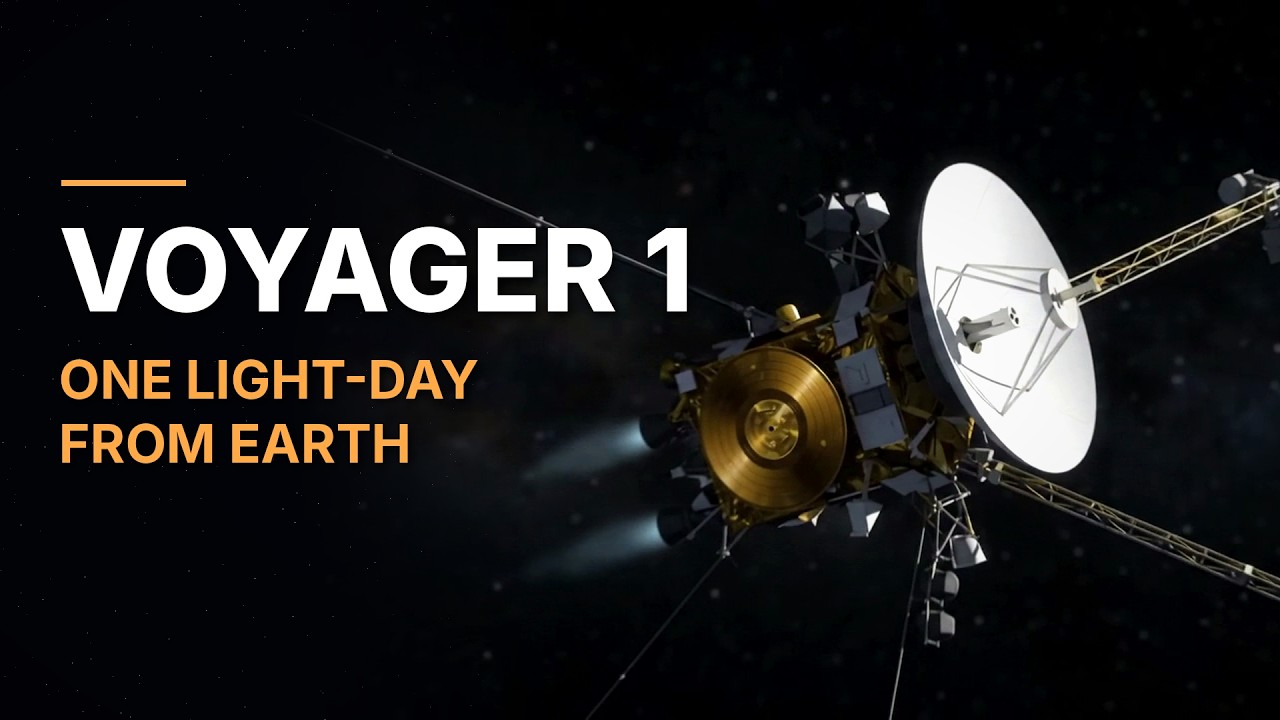
This is the extraordinary reality of NASA's Voyager 1 mission. Nearly five decades after leaving Earth, humanity's most distant operational spacecraft is approaching a historic milestone: reaching a distance of one light-day from our planet.
On November 18, 2026, Voyager 1 is scheduled to become the first human-made object to reach this extraordinary distance, approximately 16.09 billion miles (25.90 billion kilometres) from Earth.
But what does one light-day really mean? And why does this milestone matter to science, communication technology, and our understanding of the universe?
The answer reveals something remarkable about the relationship between distance, time, and the physical limits of communication.
https://www.youtube.com/@ScienceTraceOfficial
1. Understanding the meaning of one light-day
A light-day is not a measurement of time. It is a measurement of distance.
Light travels through a vacuum at approximately 299,792 kilometres per second. During 24 hours, it covers approximately 25.9 trillion metres, equivalent to 25.9 billion kilometres.
This enormous distance provides a useful way to understand the scale of space.
For comparison:
- Light travels from the Moon to Earth in approximately 1.3 seconds.
- Sunlight takes approximately 8 minutes and 20 seconds to reach Earth.
- Radio signals between Earth and Mars can require several minutes to more than 20 minutes, depending on their orbital positions.
- At one light-day, a radio signal requires approximately 24 hours to travel in one direction.
Voyager 1 is approaching this final milestone after travelling through space since September 5, 1977.
Its journey demonstrates how far human engineering can reach, even when travelling at speeds far below the speed of light.
2. The extraordinary journey of Voyager 1
NASA launched Voyager 1 in 1977 as part of a mission to explore the outer planets.
Its encounters with Jupiter and Saturn transformed planetary science. The spacecraft observed complex atmospheric structures, discovered important features of planetary moons, and expanded scientific understanding of the outer Solar System.
After its Saturn encounter in 1980, Voyager 1 continued outward on a trajectory away from the major planets.
In August 2012, it crossed the heliopause, the boundary where the solar wind's influence gives way to the surrounding interstellar environment.
This achievement made Voyager 1 the first human-made spacecraft to enter interstellar space.
However, entering interstellar space does not mean leaving the entire Solar System. The Sun's gravitational influence extends much farther, including into the distant Oort Cloud.
Voyager 1 is therefore exploring interstellar space while continuing its much longer journey through the Sun's wider gravitational neighbourhood.
3. When communication becomes a 48-hour conversation
Perhaps the most fascinating aspect of the one-light-day milestone is its effect on communication.
Voyager 1 communicates with Earth using radio waves, which travel at the speed of light.
When the spacecraft reaches one light-day:
- A command transmitted from Earth will take approximately 24 hours to arrive.
- Voyager 1 will receive that command one day later.
- Its response will require approximately another 24 hours to return.
The complete communication cycle will therefore take approximately 48 hours.
This creates an unusual situation for mission controllers.
They cannot operate Voyager 1 through immediate responses or real-time commands. Every decision must account for the enormous communication delay.
Engineers must design commands carefully, anticipate possible problems, and allow the spacecraft to perform many operations independently.
This is not simply a communication challenge. It is a demonstration of how spacecraft engineering changes when exploration extends beyond the immediate reach of human control.
4. A scientific laboratory beyond the Sun's protective bubble
Voyager 1 is more than a distant spacecraft. It is a scientific instrument studying an environment that cannot be fully reproduced in terrestrial laboratories.
Outside the heliosphere, the spacecraft measures conditions in the interstellar medium.
Its observations help researchers investigate:
- Interstellar plasma and charged particles.
- Magnetic-field properties beyond the heliosphere.
- Cosmic-ray particles travelling through interstellar space.
- The interaction between the solar environment and the surrounding galaxy.
These measurements are particularly valuable because Voyager 1 provides direct observations from a region that spacecraft had never previously explored.
Its scientific contribution is therefore not measured only by distance but also by the unique information it continues to transmit.
5. The engineering challenge of keeping Voyager 1 alive
Voyager 1 was designed for a mission that would last far longer than its original planetary exploration objectives.
Yet its continued operation nearly 50 years after launch is not accidental.
The spacecraft uses radioisotope thermoelectric generators (RTGs), which produce electricity from the heat released by the natural radioactive decay of plutonium-238.
However, the electrical power available from these generators gradually decreases.
As a result, NASA engineers have had to make difficult decisions about which instruments and spacecraft systems should remain operational.
Power conservation has become essential.
The mission team has progressively adjusted spacecraft operations to extend its scientific lifetime.
This raises an important question for future exploration: How can humanity build spacecraft capable of operating independently for decades, or even centuries, beyond the reach of immediate human intervention?
Voyager 1 provides an extraordinary engineering case study.
6. The Golden Record: A message from Earth
Voyager 1 also carries one of humanity's most symbolic scientific artefacts: the Golden Record.
Developed as a representation of life and civilisation on Earth, this record contains selected sounds, images, music, and greetings in multiple languages.
It was designed as a message to any potential extraterrestrial intelligence that might encounter the spacecraft in the distant future.
The probability of such an encounter is extremely small, but the idea behind the record is significant.
Voyager 1 carries more than scientific instruments. It carries a representation of humanity's existence, creativity, and curiosity.
The spacecraft is a physical expression of our desire to explore beyond our planet and communicate across the universe.
7. What happens after one light-day?
Reaching one light-day will not suddenly change Voyager 1's physical condition.
There will be no dramatic transition, no new cosmic boundary, and no sudden change in its scientific instruments.
The milestone is significant because it provides a new way to understand the enormous distance between humanity and its farthest spacecraft.
Voyager 1 will continue moving outward through interstellar space.
Eventually, its remaining electrical power will become insufficient to operate its scientific instruments and communication systems.
Even after communication ends, the spacecraft will continue travelling through space, carrying the Golden Record into the distant future.
Its journey will outlast the operational lifetime of the technology that created it.
Conclusion: A day away from humanity
One light-day is an extraordinary scientific measurement, but its meaning extends beyond numbers.
For nearly 50 years, Voyager 1 has travelled farther than any other human-made object. It has explored distant planets, crossed the heliopause, and continued returning scientific information from interstellar space.
On November 18, 2026, it is expected to reach a distance where even a message travelling at the speed of light needs an entire day to arrive.
This milestone reminds us that space exploration is not simply about building faster spacecraft. It is about patience, scientific curiosity, technological endurance, and the willingness to explore places humanity may never physically reach.
Voyager 1 is now approaching a remarkable distance from Earth.
Yet every signal it sends carries evidence of something much closer: the human desire to understand the universe.
ScienceTrace — Tracing the Future of Science & Research.