Could Time Travel Be Possible? New 2026 Physics Research Explores Messages From the Future
New 2026 physics research explores whether information could travel backward through noisy closed timelike curves. The mathematics is fascinating, but no time machine exists, and other studies suggest wormholes may be too unstable to build one.
Time travel has been a favorite idea of science fiction for generations. From fictional machines that send people centuries into the past to stories about messages arriving from the future, the concept has captured the imagination of millions.
But physics has never completely dismissed the idea.
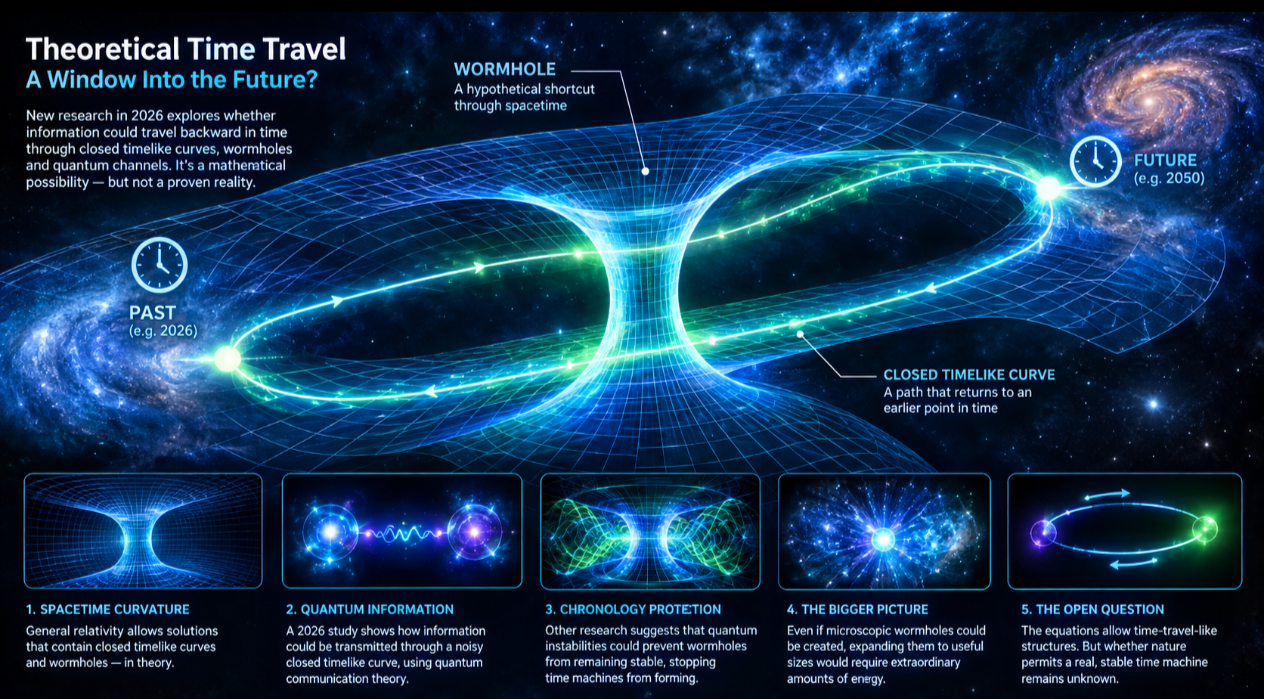
Einstein's theory of general relativity allows some remarkably strange solutions to its equations. In certain mathematical descriptions of spacetime, paths known as closed timelike curves could, in principle, loop back toward an earlier point in time.
No one has ever observed such a path in nature. No working time machine exists. Yet researchers continue to study what the laws of physics would actually allow if these unusual structures could exist.
In 2026, that research has taken an interesting new direction.
A study published in Physical Review Letters in June examined how much information could theoretically be transmitted through a noisy closed timelike curve. The work considers a remarkable possibility: information traveling from the future toward the past.
It is important to be clear about what the research does—and does not—show.
The researchers did not build a time machine or send a message into the past. Instead, they developed a mathematical framework for studying how information might behave in a hypothetical system where ordinary causality could be violated.
At the same time, other research published in 2026 has raised a different possibility: perhaps the laws of physics contain mechanisms that prevent time machines from becoming stable in the first place.
That tension is what makes the subject so fascinating. The mathematics of modern physics can describe scenarios that resemble time travel, while physical effects may make those scenarios impossible to realize.
What Does Time Travel Mean in Physics?
When physicists talk about time travel, they are not necessarily talking about the machines seen in movies.
In one sense, we are all moving through time. Every person's worldline extends through spacetime, and clocks measure the amount of proper time experienced along that path.
The surprising part is that time does not pass at exactly the same rate for everyone.
Einstein's theories of relativity show that motion and gravity can change how quickly clocks run relative to one another. This effect, known as time dilation, has been experimentally confirmed.
For example, astronauts traveling at high speeds can experience slightly less elapsed time than people who remain on Earth. The difference is normally tiny, but it is real and must even be taken into account in technologies such as satellite navigation.
So traveling into the future in the relativistic sense is not science fiction.
Traveling into the past is where the real difficulty begins.
Backward time travel would require an unusual structure in spacetime—such as a closed timelike curve (CTC)—that changes the normal relationship between cause and effect.
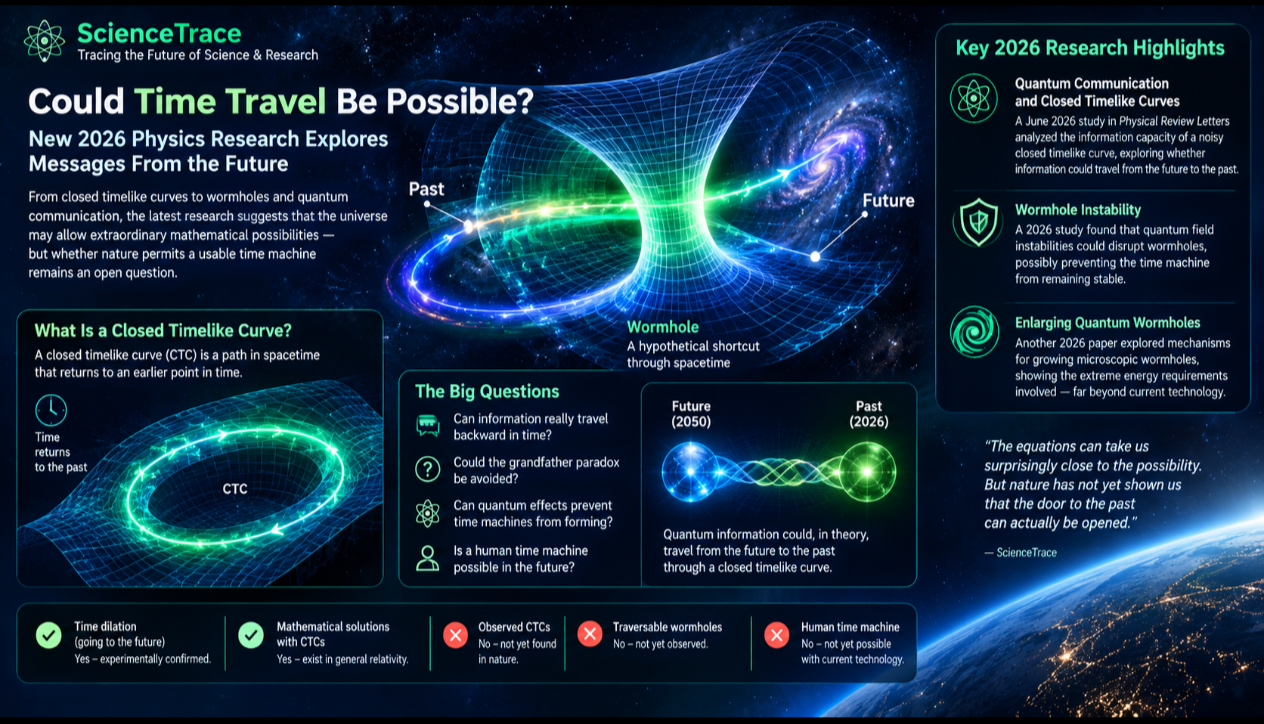
A CTC can be pictured as a path through spacetime that eventually loops back to an earlier event on that same path.
General relativity can describe mathematical solutions containing such curves. But so far, there is no experimental evidence that our universe actually contains usable closed timelike curves.
Einstein's Equations Leave an Unexpected Possibility
General relativity changed our understanding of gravity.
Instead of treating gravity simply as a force pulling objects together, Einstein's theory describes mass and energy as influencing the geometry of spacetime.
The Einstein field equations allow many different mathematical solutions. Some of those solutions contain extremely unusual structures, including geometries associated with closed timelike curves.
But there is an important distinction between finding a solution on paper and finding that structure in the real universe.
A mathematical solution can be internally consistent without being physically realizable.
That is why physicists often separate three questions:
- Can the mathematics describe it?
- Can nature actually produce it?
- Could humans ever engineer it?
Those are three very different problems.
Time travel sits at the extreme end of that distinction.
Wormholes: A Possible Route Through Spacetime
One of the most famous theoretical ideas connected with time travel is the wormhole.
A wormhole can be thought of as a hypothetical shortcut between different regions of spacetime. Instead of traveling across the normal distance separating two locations, an object would pass through a tunnel-like connection.
The concept became particularly influential after work by Michael Morris, Kip Thorne and Ulvi Yurtsever in 1988 explored how traversable wormholes could, under certain theoretical conditions, be connected with time machines.
But keeping a wormhole open is a major problem.
Theoretical traversable-wormhole models generally require unusual forms of matter or energy with properties that have not been demonstrated on the necessary scale.
There is also no confirmed observation of a traversable wormhole. NASA has likewise noted that there is currently no observational evidence for wormholes and no known method for creating one.
So although wormholes provide an intriguing mathematical laboratory, there is a huge difference between writing down a wormhole solution and constructing one.
The New 2026 Quantum Time-Travel Research
One of the most unusual developments in 2026 comes from Kaiyuan Ji, Seth Lloyd and Mark M. Wilde.
Their paper, "Retrocausal Capacity of a Quantum Channel: Communicating through Noisy Closed Timelike Curves," was published in Physical Review Letters on June 11, 2026.
The researchers were not trying to design a machine that a person could step into. Instead, they approached the problem through quantum information theory.
Imagine, purely as a theoretical exercise, that a noisy closed timelike curve existed. Could it be used to send information backward through time? And if it could, how much information could such a channel carry?
Those questions led the researchers to study the communication capacity of this hypothetical system. Their work provides mathematical characterizations of both one-shot and asymptotic communication capacities for the model.
That changes the way the problem can be examined. Rather than asking the broad science-fiction question—"Can we travel through time?"—physicists can ask a much more precise question:
If a backward-in-time communication channel existed, how would information behave inside it?
The study connects the problem with concepts from quantum information theory, including max-information and regularized Doeblin information.
The result is interesting precisely because it stays within the realm of theoretical physics.
- There was no experimental transmission of a message into the past.
- The researchers did not demonstrate that closed timelike curves exist.
- The paper does not provide an engineering blueprint for a time machine.
It examines what would happen if such a theoretical structure were physically available.
Could Information Really Travel to the Past?
This leads to an even stranger question.
Imagine a scientist in 2050 discovers a new equation. That scientist somehow sends the equation back to a researcher in 2026. The 2026 researcher publishes it. Twenty-four years later, the 2050 scientist learns the equation from that publication and sends it back to 2026.
Where did the equation originally come from?
This is the basic idea behind the bootstrap paradox.
There is another famous problem: the grandfather paradox. A time traveler goes into the past and changes an event that prevents the time traveler from ever being born. If the traveler was never born, who went back and changed the event?
These puzzles do not by themselves prove that backward time travel is impossible. Instead, they show how seriously it would challenge our ordinary understanding of causality.
Any complete theory allowing past-directed time travel would need to explain how these apparent contradictions are resolved.
Hawking's Chronology Protection Idea
There may be a reason we have never encountered a time machine.
Physicist Stephen Hawking proposed what became known as the chronology protection conjecture. The basic idea is that the laws of physics might prevent large-scale violations of causality from occurring.
In his 1992 paper, Hawking examined what could happen as spacetime approaches the formation of closed timelike curves. Quantum effects and gravitational backreaction could potentially become so strong that the proposed time-travel structure destroys itself before a closed timelike curve can actually form.
If that idea is correct, the universe would effectively protect its own chronology.
In other words, general relativity might mathematically allow certain time-travel geometries, while quantum physics prevents those geometries from becoming physically usable.
This remains a conjecture rather than an experimentally established law.
A 2026 Study Points to Wormhole Instability
Recent theoretical work has added another piece to this puzzle.
A 2026 study published in The European Physical Journal C investigated a relativistic scalar field in a theoretical Morris–Thorne traversable wormhole.
The researchers found unstable modes in their mathematical analysis. These modes can grow with time, suggesting that the wormhole configuration may not remain stable.
That matters because a time machine would require much more than a mathematically possible geometry. The structure would have to survive long enough—and remain stable enough—to be physically useful.
If quantum or relativistic fields destabilize the wormhole, the structure could collapse or otherwise change before it could be turned into a time machine.
The authors discuss their findings in the context of Hawking's chronology protection conjecture. However, the result is theoretical. It is not experimental evidence that the universe universally prevents time travel.
Could Tiny Wormholes Ever Become Large?
Another 2026 study has approached the problem from a different direction.
Published in Scientific Reports in May 2026, "Local expansion mechanisms for quantum-scale wormholes" explores a theoretical mechanism for enlarging hypothetical microscopic wormholes.
The idea is intriguing because some theories of quantum gravity allow spacetime to behave very differently at extremely small scales. But turning a microscopic structure into something large enough for practical use is another matter entirely.
The calculations in the study involve enormous stress-energy requirements. One illustrative configuration reaches an energy scale comparable to the energy released by a typical supernova.
That does not mean scientists have discovered a way to build a wormhole using a supernova. Rather, it illustrates the extraordinary physical requirements involved in trying to turn a theoretical microscopic structure into something macroscopic.
Even if quantum-scale wormholes existed, making one large and stable would be an enormous challenge.
Not Every Wormhole Is a Time Machine
Another 2026 theoretical study examined a spinning Morris–Thorne wormhole solution.
The model includes interesting features associated with rotation and an ergoregion under certain conditions. Yet its causal structure can remain stably causal and free of closed timelike curves.
This is an important distinction that is sometimes lost in popular discussions.
A wormhole does not automatically create a time machine.
A wormhole is a particular type of spacetime geometry. Whether that geometry permits closed timelike curves depends on its detailed structure and physical conditions.
So simply discovering a wormhole would not automatically mean that backward time travel had been discovered.
So, Is Time Travel Possible?
With today's evidence, there is no demonstrated way to send a person, spacecraft, or ordinary message into the past.
Scientists have also not observed a traversable wormhole or a usable closed timelike curve.
What exists instead is a growing body of theoretical work exploring what the laws of physics might permit.
| Question | Current scientific picture |
|---|---|
| Can time pass at different rates? | Yes, experimentally confirmed |
| Can relativity describe unusual spacetime geometries? | Yes |
| Do mathematical solutions containing CTCs exist? | Yes |
| Have CTCs been observed experimentally? | No |
| Have traversable wormholes been observed? | No |
| Can quantum theory model hypothetical retrocausal communication? | Yes, as a theoretical model |
| Has information actually been sent into the past? | No |
| Has a human time machine been built? | No |
| Could physical instabilities prevent time machines? | Some theoretical studies suggest this possibility |
The table captures the central point: time travel remains a theoretical possibility in some mathematical models, not an established physical technology.
The Bigger Mystery: What Exactly Is Time?
The time-travel problem eventually leads to a much deeper question.
What is time?
In general relativity, time is woven together with the three dimensions of space to form four-dimensional spacetime. Quantum mechanics, meanwhile, describes nature through quantum states, probabilities and information.
Bringing these two descriptions together is one of the major challenges in modern theoretical physics.
That is why subjects such as wormholes, closed timelike curves and retrocausal information remain relevant even if no time machine is ever built. Studying extreme possibilities can reveal where our existing theories work—and where they may be incomplete.
A theory that explains gravity and quantum mechanics together could eventually tell us much more about the nature of time itself.
The 2026 Picture: Fascinating Mathematics, No Working Time Machine
The latest research does not show that humans are close to traveling through time. What it does show is that physicists are finding increasingly sophisticated ways to investigate the problem.
The June 2026 Physical Review Letters paper treats backward-in-time communication as a problem in quantum information theory. Other 2026 research has examined whether theoretical wormholes could become unstable before they could support a time machine. And work on quantum-scale wormholes highlights the enormous physical requirements that would stand between a microscopic theoretical structure and a useful macroscopic one.
Taken together, these studies do not settle the question. Instead, they sharpen it.
The most interesting question may no longer be simply: "Can we build a time machine?"
It may be:
"Does the fundamental structure of the universe allow causality to be violated in a stable, physically realizable way?"
For now, physics does not have a definitive answer.
The mathematics can describe some extraordinary possibilities. But there is still no evidence that nature provides us with a practical route into the past.
And that may be what makes time travel such an enduring scientific mystery.
The next breakthrough may not come from building a machine at all. It may come from understanding information, quantum gravity and the nature of time itself.
References
- Ji, K., Lloyd, S. & Wilde, M. M. "Retrocausal Capacity of a Quantum Channel: Communicating through Noisy Closed Timelike Curves." Physical Review Letters 136, 230801 (2026).
- "Probing the chronology protection conjecture via scalar quasiresonance." The European Physical Journal C (2026).
- Dorau, P. & Much, A. "Local expansion mechanisms for quantum-scale wormholes." Scientific Reports 16, 16424 (2026).
- Hawking, S. W. "Chronology protection conjecture." Physical Review D 46, 603 (1992).
- Morris, M. S., Thorne, K. S. & Yurtsever, U. "Wormholes, Time Machines, and the Weak Energy Condition." Physical Review Letters 61, 1446–1449 (1988).
- Morris, M. S. & Thorne, K. S. "Wormholes in spacetime and their use for interstellar travel." American Journal of Physics 56, 395–412 (1988).
- NASA Goddard Space Flight Center. "Wormholes, Time Travel, and Faster-Than-Light Theories."
ScienceTrace Editorial Note: This article distinguishes theoretical physics from experimental evidence. The 2026 studies discussed here do not demonstrate a functioning time machine or show that information has actually been transmitted into the past. They instead explore mathematical models involving closed timelike curves, quantum information and wormhole physics. The question remains open: does the universe merely permit the mathematics of time travel, or does nature actually allow it?