Black Holes: The Universe's Most Powerful Mystery
How black holes are defined in general relativity, how astronomers measure them through stellar orbits, X-rays, gravitational waves and EHT imaging, and what remains unknown.
"Nothing can escape a black hole" is a fair one-line summary, but it hides the more interesting scientific story. Black holes are now measured, not just imagined: telescopes have tracked stars orbiting one, gravitational-wave detectors have recorded pairs of them merging, and radio arrays have resolved the glowing ring around two. This article explains what the term means in general relativity, how astronomers know such objects exist, and where the real uncertainties lie.
What the theory says
In general relativity, gravity is the curvature of spacetime produced by mass and energy. A black hole is a region from which no signal can reach a distant observer. Its boundary is the event horizon. For a non-rotating black hole of mass M, the horizon sits at the Schwarzschild radius, rs = 2GM/c2, which is about 3 kilometres for one solar mass. Compressing the Sun to that size would make it a black hole, but the Sun will never do so on its own, because its mass is too small.
The horizon is not a surface in the everyday sense. A freely falling observer would notice nothing special on crossing it for a sufficiently massive hole; the one-way nature is a property of the geometry. Real astrophysical black holes are also expected to spin, which is described by the Kerr solution, and the spin changes the shape of the horizon and the behaviour of matter nearby.
Formation: what is established and what is not
The common route to a stellar-mass black hole starts with a star that has exhausted the fuel for nuclear fusion in its core. Without outward pressure the core collapses. If what remains is below roughly two to three solar masses, it can be supported as a neutron star by neutron degeneracy pressure and nuclear forces; above an upper limit whose exact value depends on the uncertain physics of dense matter (the Tolman-Oppenheimer-Volkoff limit), nothing known can halt the collapse. Some massive stars may collapse directly without a bright supernova, and how many do is an active topic of study.
The statement that matter reaches "infinite density" at the centre comes from the classical equations, which predict a singularity. Most physicists read this as a sign that general relativity stops being adequate there and that a theory of quantum gravity is needed, not as a literal infinity in nature. Penrose's 1965 singularity theorem showed that, under reasonable conditions, collapse to a singularity is unavoidable in classical relativity, but it does not tell us what happens in a full quantum description. So the interior is genuinely unknown.
Three mass ranges
Stellar-mass black holes range from a few to a few tens of solar masses and are the end products of massive stars. Cygnus X-1 was among the first systems widely accepted to contain one, based on X-ray emission and the orbital motion of its companion star.
Supermassive black holes have millions to billions of solar masses and sit at the centres of most large galaxies. Their origin is still debated: they may grow from smaller seeds by accretion and mergers, or begin as heavier seeds formed by direct collapse of gas clouds. The detection of very massive black holes in the early universe puts pressure on growth models, and observations from the James Webb Space Telescope have intensified that discussion.
Intermediate-mass black holes, roughly a hundred to a hundred thousand solar masses, are the missing link. Gravitational-wave detectors have reported at least one merger remnant in that range, and some star clusters are candidate hosts, but the population remains poorly constrained. Calling them "still being studied" is accurate.
Seeing the unseeable: four lines of evidence
Because a black hole emits no light of its own, astronomers detect it through its effects on its surroundings.
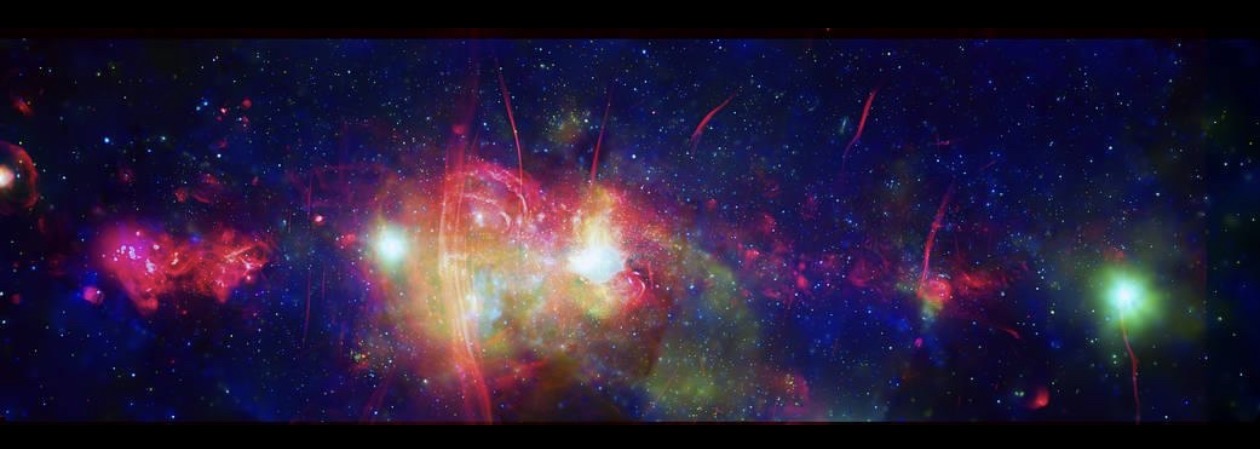
- Stellar orbits. For three decades, teams led by Reinhard Genzel and Andrea Ghez tracked stars, notably S2, in tight orbits around the compact radio source Sagittarius A* at the centre of the Milky Way. The orbits imply about four million solar masses within a region smaller than the Solar System. The work was recognised by the 2020 Nobel Prize in Physics, shared with Roger Penrose.
- Accretion and X-rays. Gas falling toward a black hole forms a hot disc, heated to millions of degrees, that radiates strongly in X-rays. Binary systems with an invisible compact companion too massive to be a neutron star are black hole candidates.
- Gravitational waves. In September 2015 the LIGO detectors recorded GW150914, the signal from two black holes of about 36 and 29 solar masses merging into one of roughly 62. This was the first direct detection of gravitational waves, and later observing runs have catalogued many more mergers.
- Radio imaging. The Event Horizon Telescope (EHT) links radio dishes across the globe into an Earth-sized interferometer.
What the EHT images are, and are not
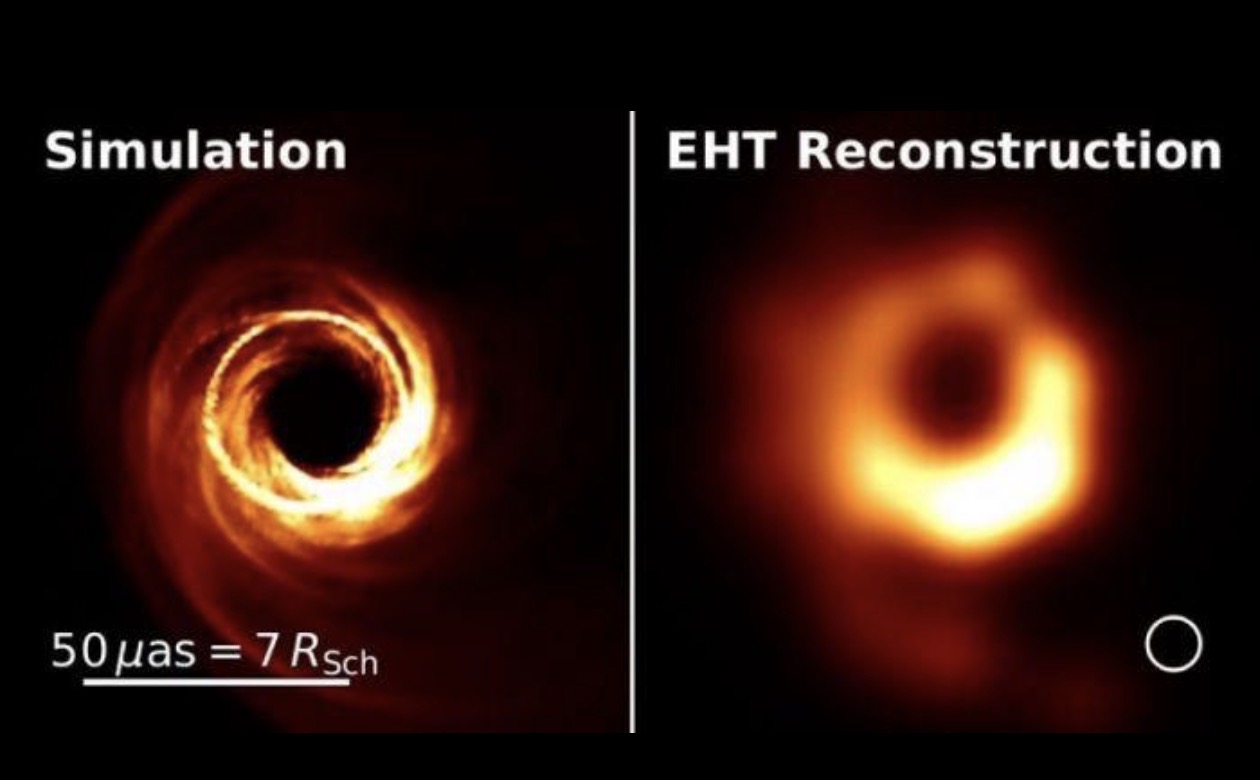
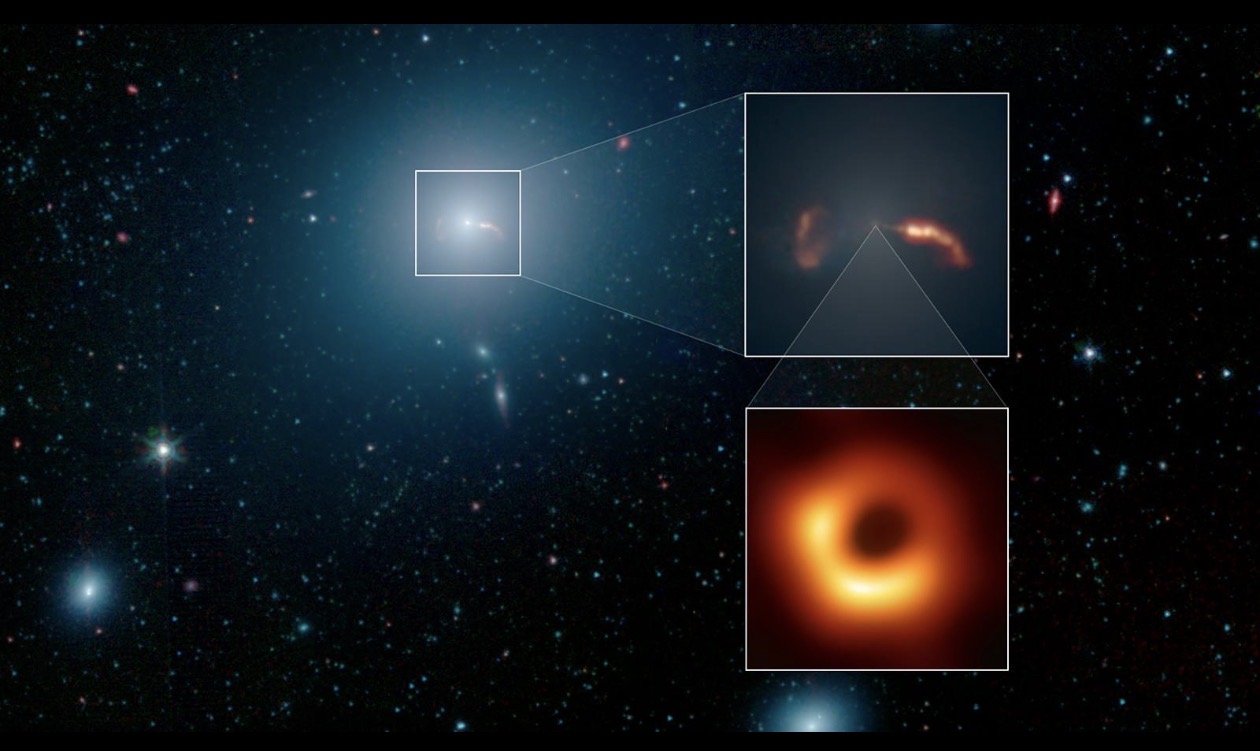
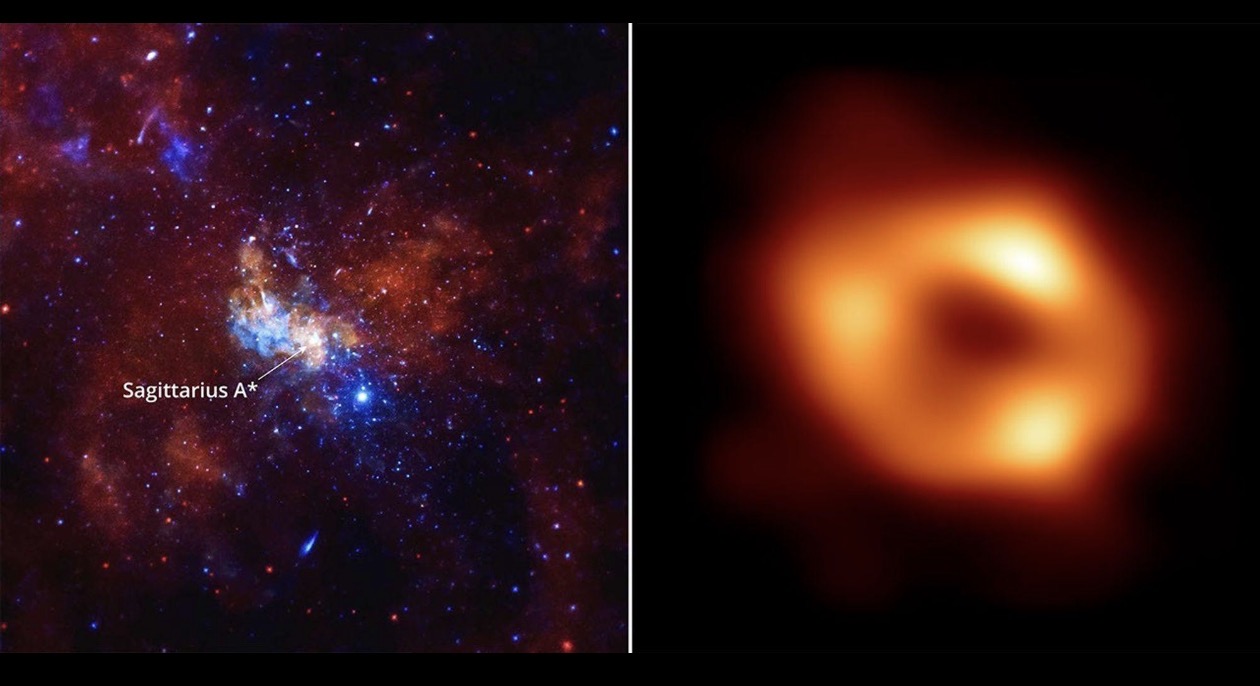
In April 2019 the EHT collaboration published its image of the supermassive black hole in the galaxy M87, based on observations made in 2017. The result showed a bright ring around a dark central depression, with a diameter consistent with a mass of about 6.5 billion solar masses. In 2022 the collaboration released the corresponding image for Sagittarius A*, with a mass of about four million solar masses, in agreement with the stellar-orbit measurements.
These are not photographs in the usual sense. Interferometers sample only some spatial frequencies of the sky, so the image must be reconstructed from sparse data using algorithms and assumptions, and the team tested several independent methods and compared the results against simulations. The dark region is the "shadow", produced by gravitational bending of light and capture by the horizon, and the ring is hot gas whose light is bent around it. The images are consistent with predictions of general relativity, but they test the theory only at a certain level of precision, and the sparse data leave room for alternative models of the nearby plasma. Sagittarius A* was harder to image than M87* because its gas changes on timescales of minutes, while M87's changes over days.
Falling in: time, light and tides
Popular descriptions of approaching a black hole are directionally right but often imprecise. Gravitational time dilation means that, from the point of view of a distant observer, clocks near the horizon run slow and signals are increasingly redshifted; the infalling observer notices nothing odd about their own clock. Light paths are strongly bent, and near a non-rotating hole there is an unstable circular photon orbit at 1.5 times the Schwarzschild radius, which sets the size of the observed shadow.
"Spaghettification" is the stretching caused by tidal forces, the difference in gravitational pull across an object's length. Counter-intuitively, tides at the horizon are far stronger for small black holes: an astronaut would be torn apart outside a stellar-mass horizon, but could cross a supermassive one while feeling little.
Hawking radiation and the information puzzle
In 1974 Stephen Hawking showed that quantum effects near the horizon should make a black hole emit thermal radiation, with a temperature inversely proportional to its mass. For stellar-mass and larger holes the temperature is far below that of the cosmic microwave background, so the effect has never been observed. If a black hole evaporates into thermal radiation, what happens to the information about what fell in? This information paradox has driven much theoretical work, and no proposed resolution has been experimentally tested.
Are black holes a danger to Earth?
No. The nearest known black hole candidates are of the order of a thousand light-years away; one identified from Gaia data lies at about 1,600 light-years. At a given distance a black hole's gravity equals that of any object of the same mass, so it does not "suck in" distant matter. Sagittarius A* is roughly 26,000 light-years away.
Limitations and open questions
- The interior. We lack a tested theory of what happens inside the horizon or near the singularity.
- Seeds of supermassive holes. The mechanism that makes billion-solar-mass objects so early in cosmic history is unresolved.
- Intermediate-mass objects. Few secure examples exist, so formation channels are poorly constrained.
- Tests of relativity. Current imaging resolution cannot yet separate general relativity from several alternatives in the strong-field regime.
- Spin and jets. How black hole spin and magnetic fields launch relativistic jets, such as the one seen in M87, is still modelled with uncertain assumptions.
What researchers should watch
- Longer EHT observations and added telescopes, aimed at time-resolved "movies" of the flow near the horizon.
- Gravitational-wave catalogues, whose growing mass and spin distributions constrain how black holes form.
- Space-based gravitational-wave observatories planned for the next decade, which would reach massive black hole mergers inaccessible to ground detectors.
References and further reading
- Event Horizon Telescope Collaboration. "First M87 Event Horizon Telescope Results. I. The Shadow of the Supermassive Black Hole." The Astrophysical Journal Letters, 875, L1, 2019.
- Event Horizon Telescope Collaboration. "First Sagittarius A* Event Horizon Telescope Results. I. The Shadow of the Supermassive Black Hole in the Center of the Milky Way." The Astrophysical Journal Letters, 930, L12, 2022.
- Abbott, B. P., et al. (LIGO Scientific Collaboration and Virgo Collaboration). "Observation of Gravitational Waves from a Binary Black Hole Merger." Physical Review Letters, 116, 061102, 2016.
- Penrose, R. "Gravitational Collapse and Space-Time Singularities." Physical Review Letters, 14, 57, 1965.
- Hawking, S. W. "Black hole explosions?" Nature, 248, 30, 1974.
- Misner, C. W., Thorne, K. S., Wheeler, J. A. Gravitation. W. H. Freeman, 1973.
- El-Badry, K., et al. "A Sun-like star orbiting a black hole." Monthly Notices of the Royal Astronomical Society, 518, 1057, 2023.