Hidden Supermassive Black Hole Reveals Itself After Destroying a Star
For decades, astronomers have believed that supermassive black holes spend their lives anchored at the centers of galaxies, where they quietly influence the motion of billions of stars. A remarkable new discovery, however, suggests that not all of these cosmic giants remain in one place.
By ScienceTrace Research Desk
For decades, astronomers have believed that supermassive black holes spend their lives anchored at the centers of galaxies, where they quietly influence the motion of billions of stars. A remarkable new discovery, however, suggests that not all of these cosmic giants remain in one place.
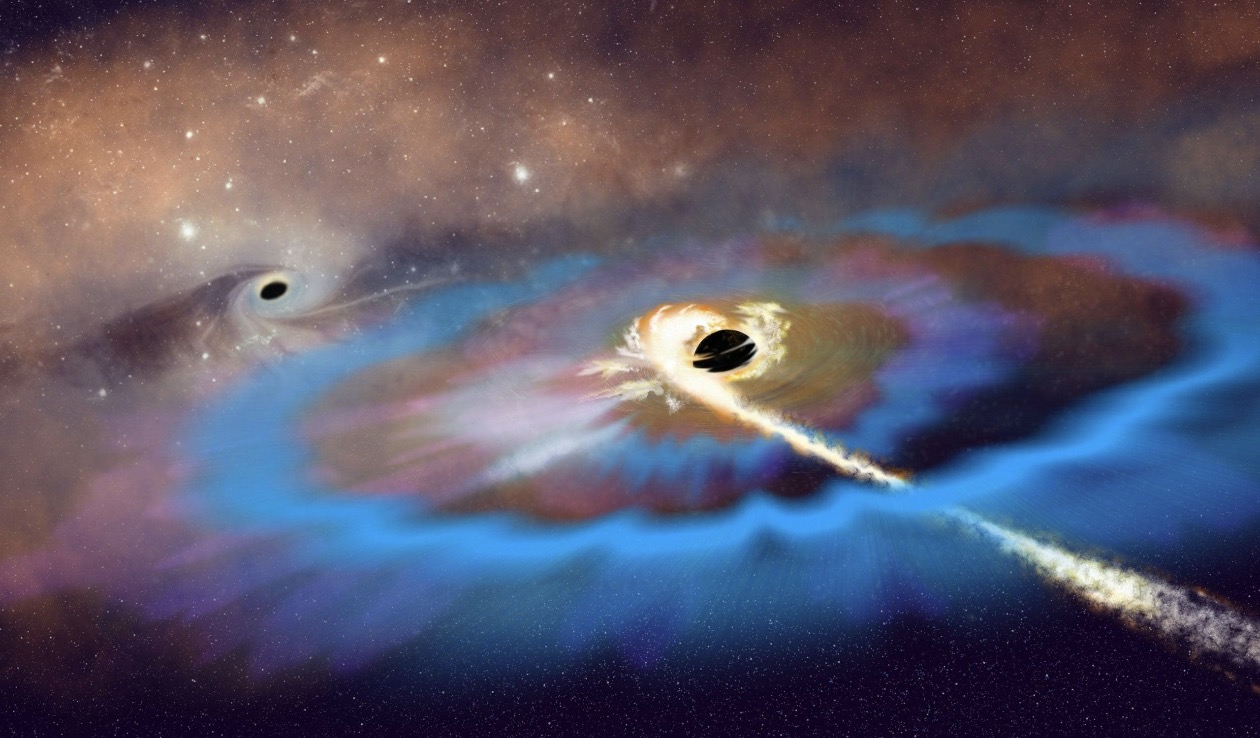
Using observations from NASA’s Neil Gehrels Swift Observatory, an international team of astronomers has identified what appears to be a wandering supermassive black hole after it tore apart an unfortunate star that ventured too close. The dramatic event has provided one of the strongest pieces of evidence yet that some supermassive black holes can drift far from the centers of their host galaxies.
The discovery offers an exciting glimpse into a hidden population of black holes that may have remained invisible for millions—or even billions—of years.
A Violent Cosmic Encounter
The event began when astronomers detected an unusually bright burst of X-rays, ultraviolet light, and visible light coming from a distant galaxy. At first glance, it looked like many other high-energy events observed across the universe. But detailed analysis revealed something much more extraordinary.
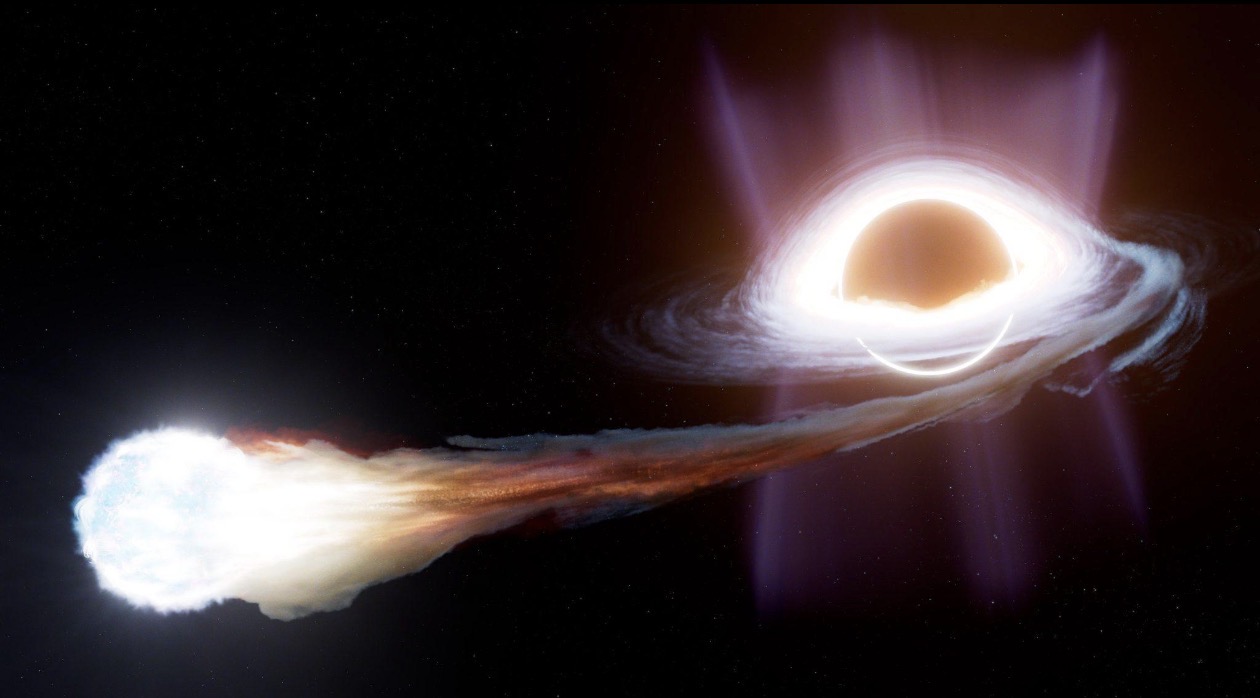
Researchers determined that the flash was caused by a tidal disruption event (TDE), a rare phenomenon that occurs when a star passes too close to a black hole.
The black hole’s immense gravitational pull stretched the star into a long stream of gas in a process known as spaghettification. As the star was torn apart, its material spiraled inward, forming a rapidly rotating disk around the black hole. Friction within this disk heated the gas to millions of degrees, producing an intense burst of radiation that space telescopes could detect across vast cosmic distances.
Without this violent encounter, the black hole would likely have remained completely invisible.
Why This Discovery Is Different
Most known supermassive black holes sit at the very centers of galaxies, where they can contain millions or even billions of times the mass of our Sun.
This newly identified object appears to be different.
Instead of occupying the galaxy’s central region, it seems to be located well away from the core. That unusual position suggests it is a wandering supermassive black hole—a rare type of black hole that has been displaced from its original location.
Astronomers believe the black hole was likely pushed away from the galactic center after a merger between two galaxies.
When galaxies collide, their central black holes eventually move toward one another through gravity. During this complex interaction, powerful gravitational forces can sometimes eject one of the black holes or leave it orbiting far from the center. Although scientists have predicted this process for years, direct evidence has been difficult to obtain because inactive black holes emit virtually no light.
This discovery changes that.
Finding the Universe’s Hidden Giants
Black holes are famously difficult to observe because they do not produce light on their own. Instead, astronomers detect them by studying how they affect nearby stars, gas, or other objects.
A wandering black hole presents an even greater challenge.
Unlike central supermassive black holes, which often feed on surrounding gas and remain relatively active, wandering black holes may spend millions of years moving through regions where there is very little material to consume. As a result, they remain almost completely invisible until a star happens to wander into their gravitational grasp.
Scientists believe there could be many more of these hidden giants scattered throughout galaxies across the universe.
Each new discovery helps researchers estimate how common wandering black holes really are and provides valuable information about the history of galaxy mergers.
A Window Into Galaxy Evolution
The discovery has implications far beyond a single black hole.
Galaxy mergers are among the most powerful events in the universe. Over billions of years, galaxies frequently collide and combine, reshaping their structure and triggering bursts of star formation.
Understanding what happens to the supermassive black holes during these mergers is one of modern astronomy’s biggest challenges.
If wandering black holes are more common than previously thought, they could influence how galaxies evolve, how stars are distributed, and how future black hole mergers occur.
The findings also help scientists improve computer simulations that model the evolution of galaxies over cosmic time.
Looking Ahead
Astronomers expect future observatories to uncover many more wandering black holes.
NASA’s upcoming Nancy Grace Roman Space Telescope, the Vera C. Rubin Observatory, and the European Space Agency’s Euclid mission will survey enormous regions of the sky with unprecedented sensitivity. These next-generation facilities are expected to detect many more tidal disruption events, giving researchers additional opportunities to locate hidden black holes that would otherwise escape detection.
Each new observation will help answer fundamental questions about how supermassive black holes grow, how often galaxies merge, and how these mysterious objects shape the universe around them.
A Universe Full of Surprises
Every major astronomical discovery reminds us that the universe is more complex than we once imagined.
The detection of a wandering supermassive black hole challenges the long-held assumption that these enormous objects always remain fixed at the centers of galaxies. Instead, it suggests that some may spend millions of years drifting through space, unseen until a chance encounter with a star briefly illuminates their presence.
For scientists, discoveries like this are more than spectacular cosmic events. They provide crucial evidence that helps explain how galaxies evolve and how the largest black holes in the universe came to exist.
As new telescopes continue to explore the cosmos, astronomers expect many more hidden giants to emerge from the darkness. Each discovery will bring us one step closer to understanding the extraordinary forces that have shaped the universe for more than 13 billion years.
Source: NASA’s Neil Gehrels Swift Observatory.