Scientists Observe Strange Quantum Pattern That Challenges How We Understand Reality
Structured interference found inside scrambled many-body quantum dynamics breaks no law. We explain scrambling, echo measurements, and what the results do and do not show.
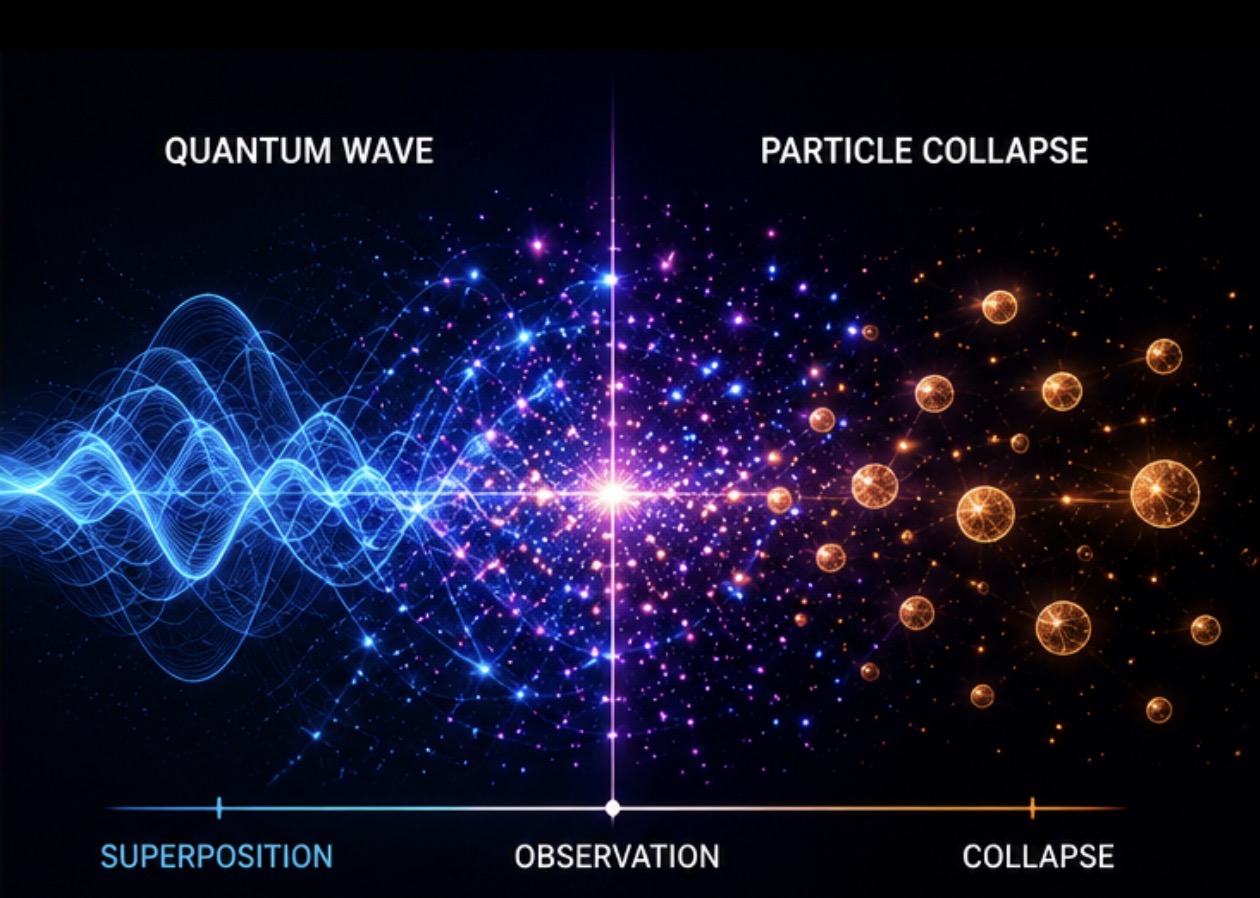
Reports of a "strange quantum pattern that challenges reality" are almost always about something more specific and more interesting than the headline: a measurement that reveals structure in a system that was expected to look like noise. This article explains the physics behind that idea, which is the behaviour of information in strongly interacting quantum systems. It also says plainly what the results do not show. No known law has been broken. The substance is in how researchers have learned to see order inside quantum chaos.
Scrambling: why many-body quantum systems look random
In a system of many interacting quantum particles, such as the qubits of a quantum processor, local information does not stay local. An initial state in which one qubit carries a particular piece of information spreads, through interactions and entanglement, into correlations between many qubits. After a short time, no measurement on a few qubits reveals the original information; it is encoded in the whole. This is called scrambling (Hayden and Preskill, Journal of High Energy Physics, 2007; Sekino and Susskind, Journal of High Energy Physics, 2008). It is closely related to thermalisation: closed quantum systems that are chaotic tend to look thermal for local observables, a connection captured by the eigenstate thermalisation hypothesis (Srednicki, Physical Review E, 1994; reviewed by Polkovnikov and colleagues, Reviews of Modern Physics, 2011).
The consequence for experiments is that ordinary measurements of a scrambled state look like random noise. That is the sense in which the original article spoke of structure emerging "from what should normally appear as random noise."
How hidden structure is recovered: echoes and out-of-time-order correlators
Quantum mechanics is reversible in principle, so a scrambled state can be unscrambled if the dynamics are run backward. The experimental idea is an echo protocol: evolve the system forward with some interactions, apply a small perturbation to one qubit, evolve backward, and measure how much of the original state returns. If the system is highly chaotic, the small perturbation spreads and the echo is weak. The measured quantity is an out-of-time-order correlator (OTOC), which was introduced in an older context in superconductivity theory and has become a standard diagnostic of chaos and information spreading (Maldacena, Shenker and Stanford, Journal of High Energy Physics, 2016).
The recent Google Quantum AI work, as we understand it from the published abstract, used a superconducting processor to measure such correlators and reported interference between many different quantum paths that add constructively in these echoes, at the edge of quantum ergodic dynamics (Google Quantum AI and collaborators, Nature, 2025). The conceptual point is that the echo signal is sensitive to the phases of many amplitudes, so it carries information that conventional measurements of scrambled states do not. The same experiment is also described as hard to simulate on classical computers, which is part of the group's argument for its relevance to quantum advantage. That claim needs independent testing, and we do not endorse it here beyond reporting it.
What is established
- Scrambling, thermalisation and the use of OTOCs are well-developed theory, with decades of work behind them.
- Programmable superconducting and trapped-ion devices can run circuits deep enough to enter the regime where classical simulation becomes expensive. Google's 2019 random circuit sampling experiment (Arute and colleagues, Nature, 2019) is the best-known example, and the claim that it exceeded classical capability has itself been contested by improved classical algorithms.
- Echo-type measurements can be more sensitive to the system's quantum coherence than direct readout of observables.
What is speculative or unproven
- That OTOC-style measurements will provide a practical advantage for a useful task, such as extracting parameters in molecular or materials problems. This is a proposal and a direction of research.
- That the observed structure reflects something about quantum gravity or black-hole physics. The mathematical analogy to black hole scrambling is real, but an analogy in a laboratory device is not evidence about gravity.
- That the specific features seen are free of noise-related artefacts at the largest circuit sizes. Noise damps echoes, and distinguishing a genuine interference effect from a noise-induced pattern requires careful calibration and error analysis.
What the study is not saying
Viral readings of experiments like this one say that reality is "controlled by observation" or that physics is broken. Nothing in the underlying work supports either idea. The measurement problem is as open as it was before, and these experiments use the standard formalism of quantum mechanics throughout. What is new is the ability to probe the formalism's predictions in regimes that were previously inaccessible to experiment or to classical simulation. A result can be technically impressive and conceptually conservative at the same time.
Limitations and open questions
- Noise and calibration. Gate errors, crosstalk and decoherence reduce echo contrast. How a result scales with the number of qubits and circuit depth is central.
- Classical simulability. Claims of intractability have repeatedly been narrowed by new tensor-network and sampling methods. A conclusion that a measurement is beyond classical simulation is provisional.
- Reproducibility across platforms. Confidence rises when an effect appears on other hardware, such as trapped ions, neutral atoms or other superconducting architectures.
- Interpretation. Different groups use the term "chaos" for different diagnostics (spectral statistics, OTOCs, entanglement growth), and they do not always agree.
Questions worth testing
- Does the echo signal survive when noise is increased deliberately in a controlled way, and does it decay as noise models predict?
- Do independent groups on different hardware find the same constructive-interference signature?
- Can the measurement be used to estimate a physical parameter in a system whose answer is independently known, as a validation?
- How does the signal scale with system size, and where do the best classical methods stop reproducing it?
Understanding how quantum information is scrambled and how it can be partially recovered also bears on error correction and control, because both are about keeping fragile correlations from leaking into the environment. The significance of these experiments lies there, in better tools for studying complexity, and not in any challenge to reality itself.
References and further reading
- Srednicki, M. Chaos and quantum thermalization. Physical Review E, 1994.
- Polkovnikov, A., Sengupta, K., Silva, A. and Vengalattore, M. Colloquium: Nonequilibrium dynamics of closed interacting quantum systems. Reviews of Modern Physics, 2011.
- Hayden, P. and Preskill, J. Black holes as mirrors: quantum information in random subsystems. Journal of High Energy Physics, 2007.
- Sekino, Y. and Susskind, L. Fast scramblers. Journal of High Energy Physics, 2008.
- Maldacena, J., Shenker, S. H. and Stanford, D. A bound on chaos. Journal of High Energy Physics, 2016.
- Arute, F. et al. Quantum supremacy using a programmable superconducting processor. Nature, 2019.
- Google Quantum AI and collaborators. Observation of constructive interference at the edge of quantum ergodicity. Nature, 2025.