Could Humans Really Live on Mars? The Future of a Red Planet Colony
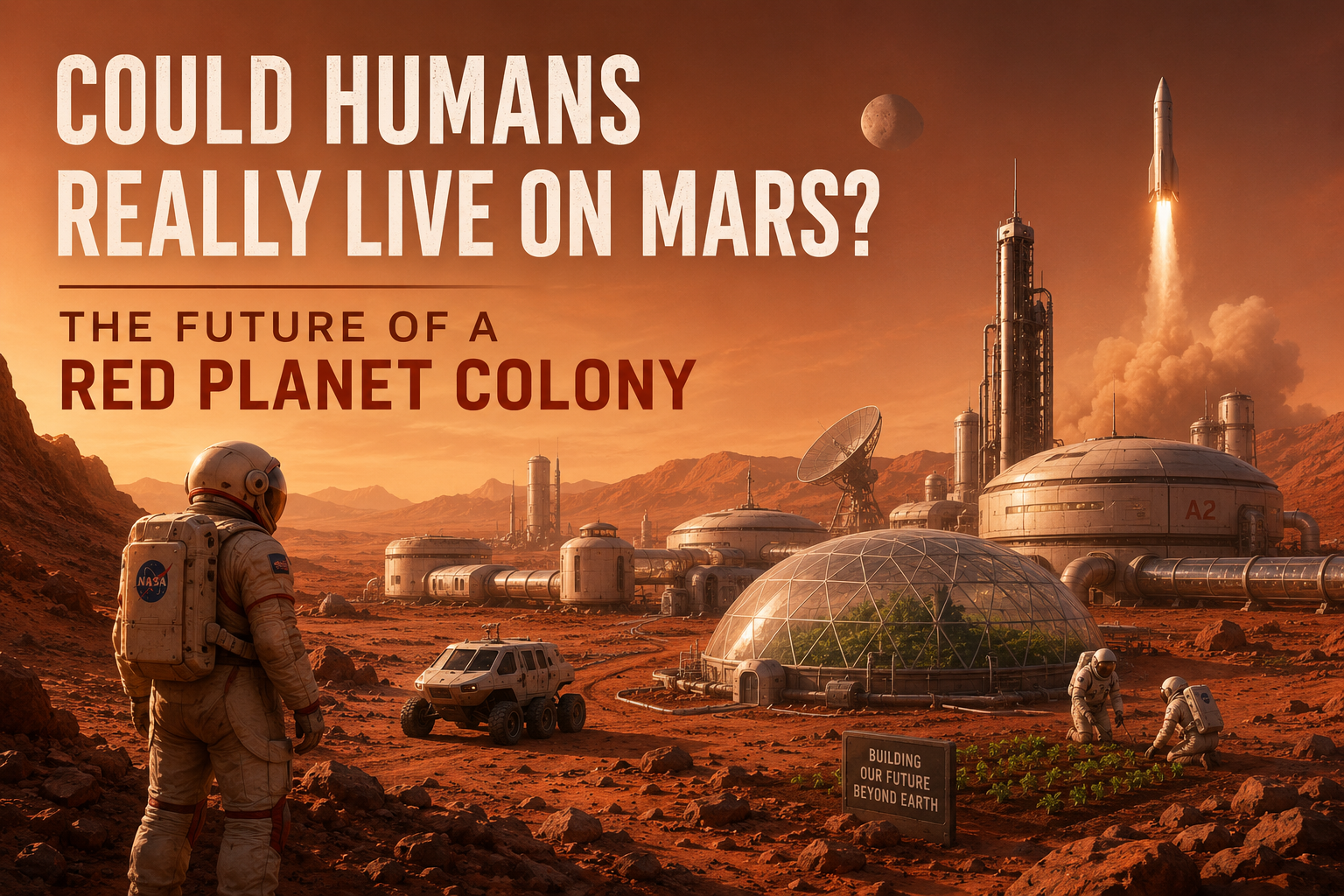
Mars has captivated human imagination for centuries. But could we actually build a colony there? Explore the science, challenges, and future of human settlement on the Red Planet.
The Dream of Mars: Turning Science Fiction Into Reality
For decades, Mars has existed only in our imaginations — a distant red dot in the night sky, the backdrop of countless science fiction stories. But today, that dream is closer to reality than ever before. With private space companies and government agencies actively developing Mars missions, the question is no longer if humans will go to Mars, but when — and more importantly, whether we could actually live there.
Why Mars?
Of all the planets in our solar system, Mars is the most Earth-like. A Martian day lasts 24 hours and 37 minutes — almost identical to ours. Mars has polar ice caps, seasonal changes, and evidence of ancient rivers and lakes. Scientists have even found signs of subsurface liquid water. These factors make Mars the most promising candidate for human colonization beyond Earth.
But Mars is also brutally hostile. The average surface temperature is -60°C (-80°F). The atmosphere is 95% carbon dioxide — unbreathable for humans — and too thin to block harmful radiation from the Sun. Atmospheric pressure on Mars is less than 1% of Earth's. Without protection, a human on the Martian surface would face radiation poisoning, extreme cold, and suffocation simultaneously.
Life Inside a Mars Colony
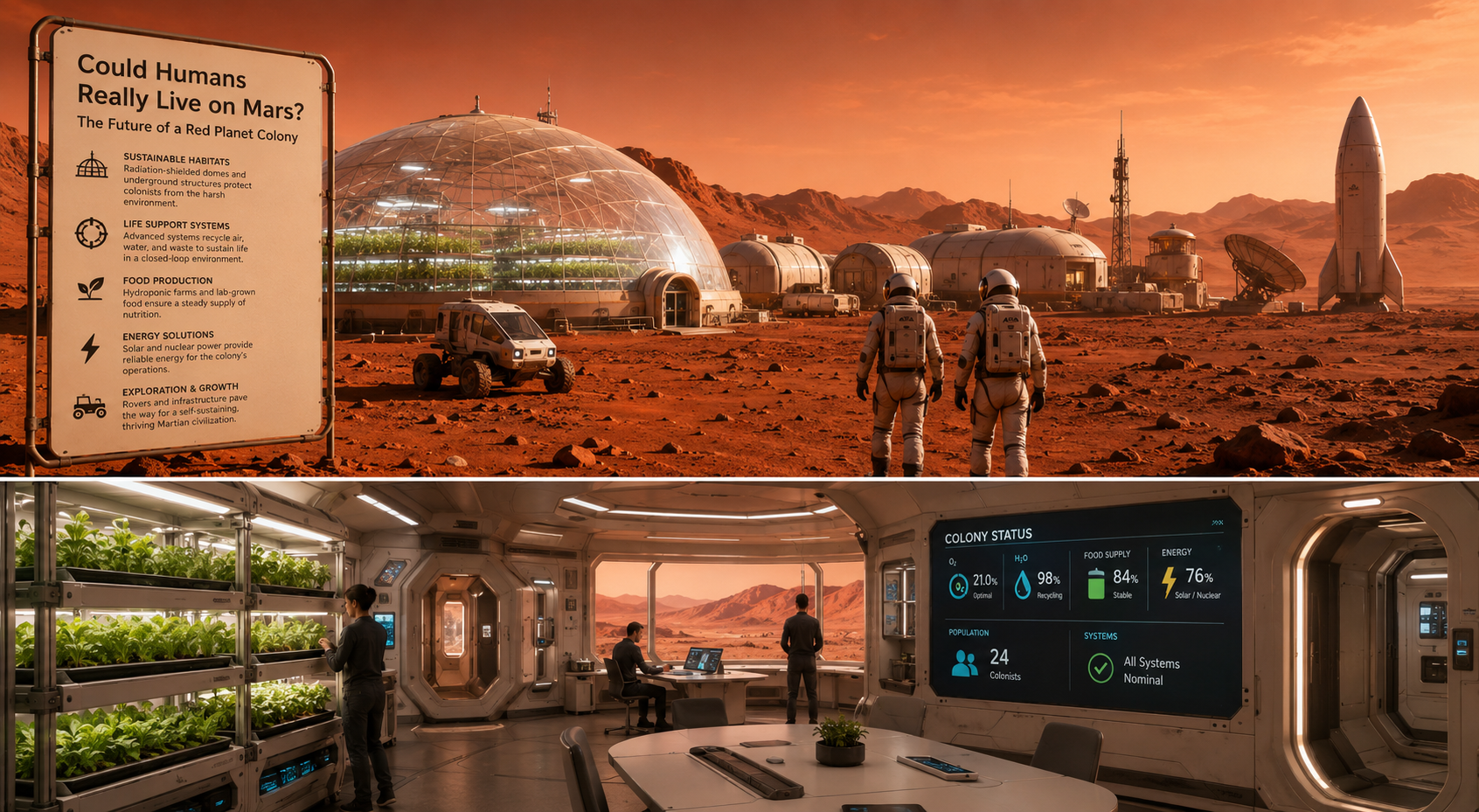
As the infographic above illustrates, a functioning Mars colony would require sophisticated interconnected systems working in harmony. From biodomes growing food to advanced life-support technology and real-time colony monitoring — every system is critical for survival.
Habitat and Shelter
Colonists would need to live in pressurized habitats. Early Mars bases would likely be prefabricated modules transported from Earth, while future colonies could use in-situ resource utilization (ISRU) — building structures from Martian soil (called regolith). Underground living is another option, as the Martian rock provides natural shielding from radiation.
Food and Water
Mars colonists cannot rely on Earth for food — the journey takes 7–9 months each way. Self-sufficiency is essential. Scientists envision large biodome greenhouses growing crops in controlled environments. Mars soil contains perchlorates (toxic to humans), so crops would need hydroponics or specially treated soil. Water can be extracted from underground ice deposits using drilling technology.
Life Support Systems
Breathing on Mars means engineering your own air. Oxygen can be produced through electrolysis of water or by the MOXIE experiment — which already demonstrated CO₂-to-oxygen conversion on the Perseverance rover. Carbon dioxide scrubbers, temperature regulation systems, and redundant life-support backups would be non-negotiable.
The Psychological Challenge
Beyond the physical challenges, the psychological toll of living on Mars may be the hardest to overcome. Colonists would be 225 million kilometers from home on average, with communication delays of 4–24 minutes each way. There would be no quick rescue if something went wrong. Isolation, confinement, and the constant awareness of danger would test the limits of human resilience.
Timeline: When Could It Happen?
SpaceX has outlined ambitious plans to land humans on Mars as early as the late 2020s. NASA's Moon-to-Mars program aims for crewed Mars missions in the 2030s. Most experts agree that a permanent settlement is still decades away — but the foundations are being laid right now through robotic exploration, technology development, and international collaboration.
Could Mars Become a Second Home for Humanity?
The honest answer is: yes, but it will take generations of work, sacrifice, and innovation. Mars colonization is not just a scientific endeavor — it's a test of humanity's will to survive and expand beyond the cradle of Earth. Whether driven by the need for a planetary backup, resource extraction, or pure exploration, the Red Planet beckons.
The Mars colony of the future may look nothing like what we imagine today. But one thing is certain — the humans who first call Mars home will be among the most extraordinary people who ever lived.
"Mars is there, waiting to be reached." — Buzz Aldrin